


























Single-wire winding and multi-wire parallel winding on fully automatic stator winding machines represent two fundamentally different winding implementation approaches, resulting in significant differences in application scenarios, equipment requirements, and process effects. Below, Vacuz will provide a brief introduction!

I’ve compiled a core comparison table for you, which will clearly show their differences:
1. Core Principle: Using a single enameled wire, winding all turns within the stator slot. Suitable for lower-power, cost-sensitive motors, with thicker wire diameters (>0.8mm) to avoid damaging the enamel coating. Relatively basic; general-purpose, fully automatic winding machines can meet this requirement.
2. Using multiple (e.g., 2-30+) identical enameled wires wound in parallel to form a single-phase winding. Suitable for high-power, high-performance motors, pursuing higher torque and efficiency, for very fine wire diameters (<0.3mm). To improve production efficiency, a more precise tension control system, a more robust machine structure, and a more complex control system are required.
Detailed Explanation of Technical Differences
1. Tension Control: A Leap in Difficulty from “Point” to “Surface.”
Single-wire winding: Only one tension source needs to be controlled, making tension control relatively simple. The equipment uses a servo motor and tension sensor to ensure constant tension on a single wire during winding, preventing breakage or overstretching.
Multi-wire winding: Requires simultaneous and accurate control of the independent tension of each wire, which is one of the technical challenges. Uneven tension in each wire can lead to unbalanced winding resistance, uneven heating, and even frequent wire breakage during production. Therefore, multi-wire winding equipment is usually equipped with a multi-channel independent closed-loop tension control system, which is much more expensive and technically demanding.
2. Wire Path: A Processing Challenge from “Neatness” to “Precision.”
Single-wire winding: Wire path is relatively simple; single or multiple layers can be neatly arranged through the relative movement of the winding needle (nozzle) and the stator. For thicker wires, the equipment’s precision wire path function ensures that each turn is tightly adjacent and does not overlap.
Multi-wire winding: Multiple wires are output simultaneously, making them prone to tangling and knotting at the guide nozzle. Therefore, the equipment requires wider guide pin slots or specially designed wire-laying dies to ensure that multiple wires run parallel without interference. Simultaneously, a more accurate wire-laying trajectory is required to form a uniform and flat coil within the stator slots.
3. Equipment Structure: Hardware Upgrade from “General” to “Reinforced.”
Single-wire winding: The mechanical rigidity requirements for the equipment are generally moderate; a standard multi-axis servo control system is sufficient.
Multi-wire parallel winding: Due to the simultaneous pulling of multiple wires, the total tension load is greater, thus placing higher demands on the rigidity and stability of the winding machine’s frame, spindle, and winding head to prevent vibration from affecting wire-laying accuracy. The equipment often requires a heavier body structure and a more powerful servo motor.
Selection and Design Recommendations:
Choosing between single-wire and multi-wire winding essentially involves balancing motor performance, production costs, and process feasibility:
1. For performance, choose multi-wire parallel winding: If your goal is to design a high-efficiency, high-power-density motor, especially in high-frequency applications, multi-wire parallel winding effectively overcomes the skin effect and is the inevitable choice.
2. For wire diameter < 0.3mm, prioritize multi-wire parallel winding: When the wire diameter is very fine (e.g., 0.1mm), a single wire is prone to breakage, resulting in very low production efficiency. Using multiple wires (e.g., 5-10 wires) in parallel winding significantly increases winding speed while reducing the risk of breakage, making it a more economical solution.
3. For wire diameter > 0.8mm, insist on single-wire winding: For thicker wires, unless there are special requirements, single-wire winding is a more reliable choice. Multiple thick wires wound in parallel are difficult to arrange, and the internal stress is enormous, easily damaging the insulation layer.
4. For general applications, prioritize cost and choose single-wire winding: For most common motors in household appliances, tools, and other fields, the mature technology and lower cost of single-wire winding are sufficient to meet performance requirements.
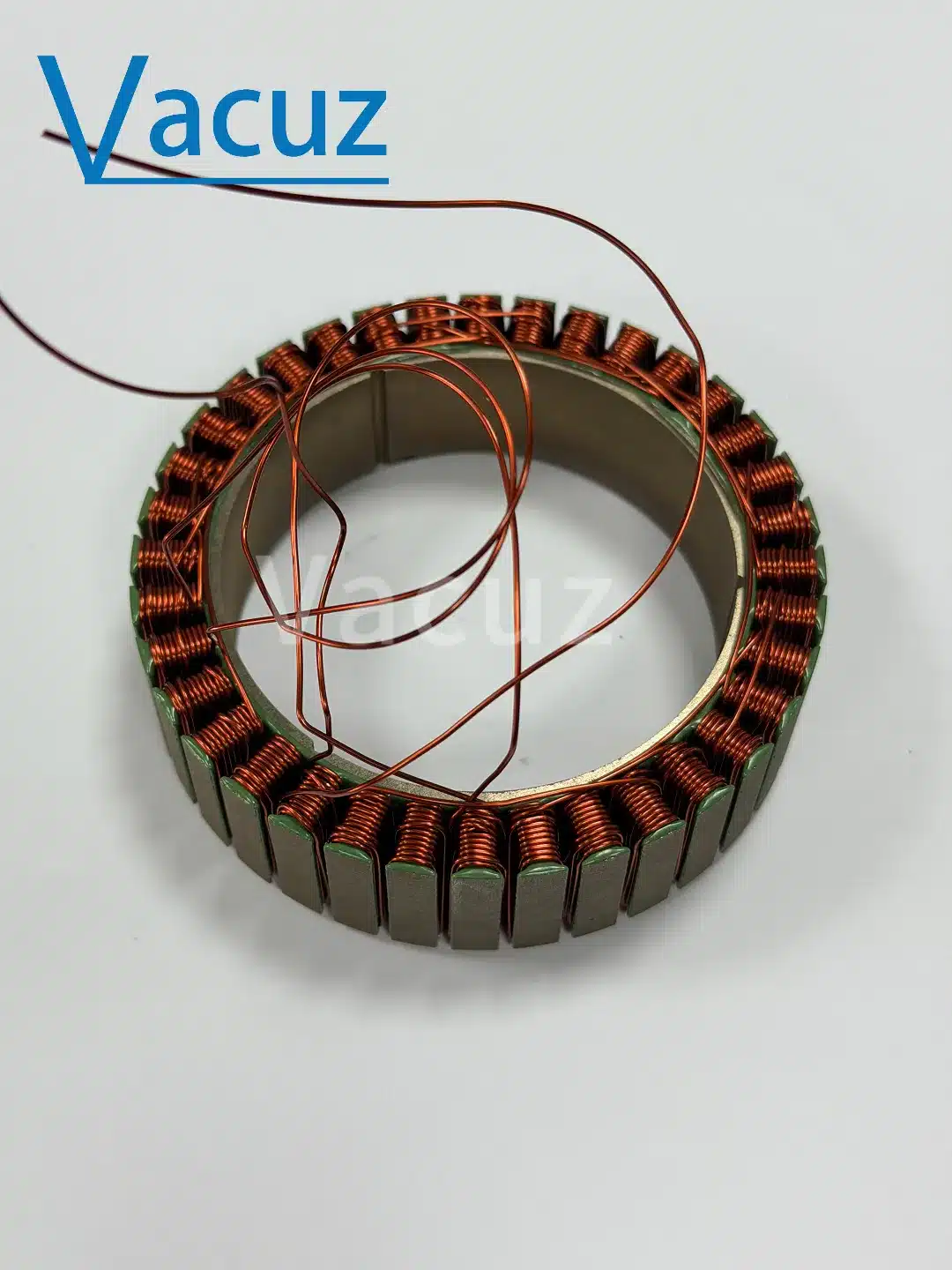
What are the differences between single-wire and multi-wire winding methods and technologies in fully automatic stator winding machines? A brief explanation has been provided above; hopefully, this information will be helpful!