















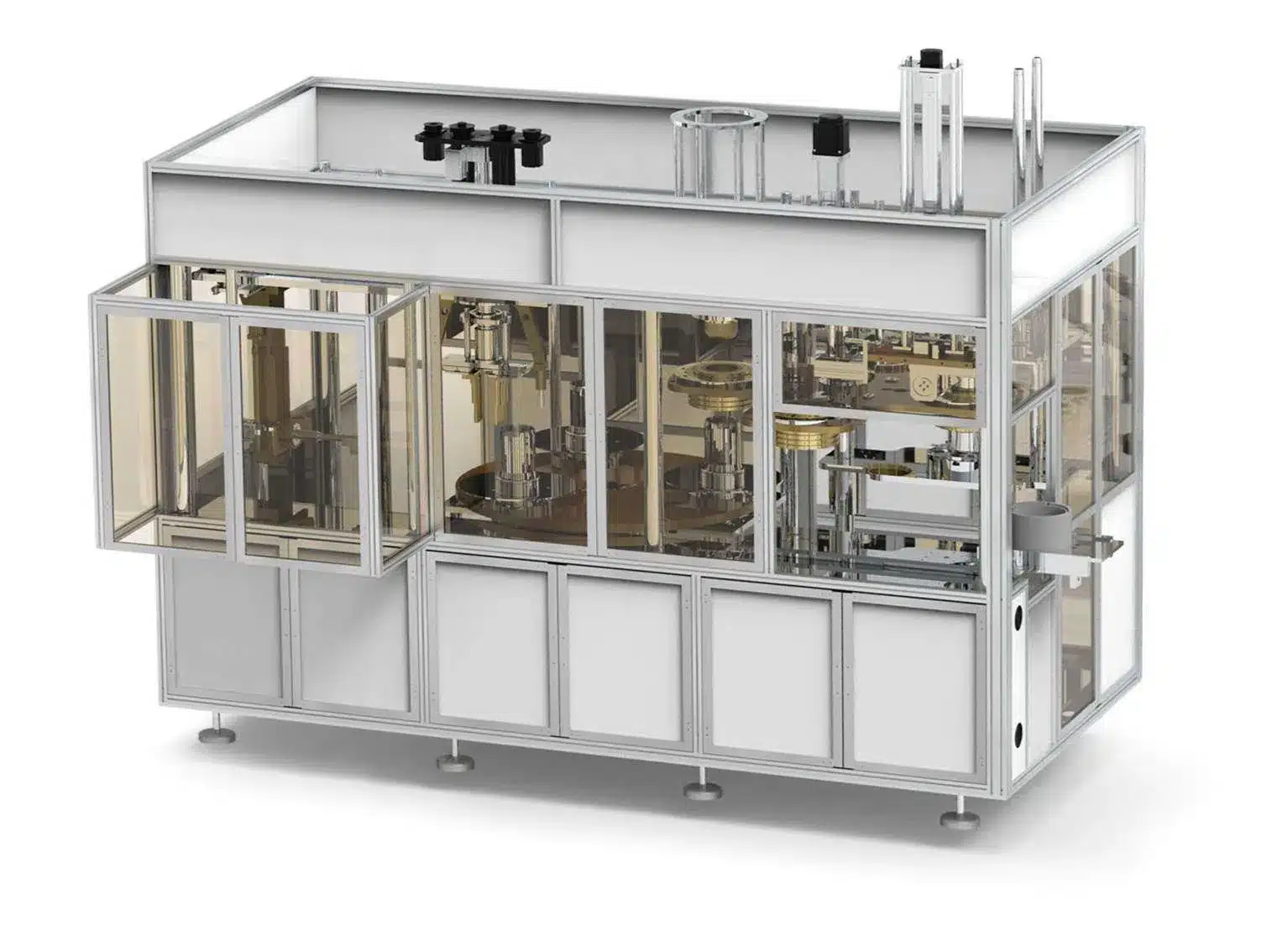
The application of drone motors is becoming increasingly widespread, and production demands are also growing. To improve the efficiency of automated assembly of drone motor rotors, the use of professional automated production line equipment is a trend. So, what are the requirements for an automated production line for drone motor rotor assembly? What are the operating procedures? Below, Vacuz will give you a brief introduction!

I. Core Requirements of Automated Production Lines
1. Equipment Precision and Stability
Hardware Configuration: Utilizes a high-rigidity frame, precision ball screws, low-backlash reducers, and a high-resolution servo drive system to ensure smooth movement and repeatability.
Transmission System: Selects low-friction, high-wear-resistant linear guides or direct drive (DD) systems to eliminate mechanical transmission backlash.
Environmental Adaptability: The equipment must operate stably in an environment with a temperature of 20-25℃ and humidity of 40-60%RH, and is equipped with air springs or magnetorheological dampers to suppress external vibration interference.
2. Automation and Intelligence
Loading and Unloading System: Integrates a vibratory feeder, conveyor belt, and robotic arm to achieve automatic feeding and sorting of parts. 3D vision cameras are used to identify the rotor core’s orientation, achieving a positioning accuracy of ±0.02mm and ensuring that the alignment error between the magnet slots and the core is ≤0.05mm.
Process Parameter Control: Segmented speed control and a linked tension control system are implemented via PLC or industrial PC to adapt to different wire diameters and stator slot types.
Data Traceability and Feedback: An RFID tag or QR code scanning system is configured to record process parameters, operator information, and test results in real time, supporting quality traceability down to the raw material batch.
3. Quality Inspection and Safety
Online Inspection: Integrates an inductance tester, insulation resistance tester, and dynamic balancing tester to achieve 100% process inspection. Dynamic balancing testing supports G1-level accuracy and is equipped with a laser velocimetry system and a de-balance drilling device to correct imbalances in real time.
Safety Protection: Complies with IEC 60204-1 electrical safety standards and is equipped with leakage protection, overload protection, and an emergency stop button. Light curtains or safety doors are installed in the operating area to prevent personnel from accidentally entering hazardous areas.
Material Management: Utilizing automated storage and retrieval systems (AS/RS) and AGVs (Automated Guided Vehicles), automated material delivery and inventory monitoring are achieved, reducing the risk of damage from manual handling.
4. Parallel and Modular Design
Process Decomposition: Serial processes are broken down into parallel workstations, seamlessly connected by AGVs or high-speed conveyors, improving equipment utilization. For example, winding, embedding, and pressing processes can be performed simultaneously, shortening the production cycle.
Modular Layout: A U-shaped production line layout is adopted, shortening material handling distances and supporting rapid changeovers. Parametric programming enables flexible production of different rotor models to meet diverse market demands.
5. High-Speed Equipment and Composite Process Integration
High-Speed Winding Machine: Winding machines with speeds ≥5000 rpm are selected, combined with torque control technology, to improve production speed and product quality.
Multi-Station Composite Equipment: Integrating winding, embedding, and pressing functions into one unit reduces workpiece turnover and lowers equipment footprint.
6. Intelligent Detection and Predictive Maintenance
AI Defect Recognition: Utilizing deep learning algorithms to build an intelligent detection system, automatically identifying defects such as broken enameled wire and misaligned wiring, with a recognition rate ≥99.5%.
Predictive Maintenance: Installing vibration sensors on key components, using big data analysis to provide early warnings of faults 3-7 days in advance, reducing unplanned downtime.
II. Automated Production Line Operation Process
1. Incoming Material Preparation and Inspection
Strict quality inspection is conducted on raw materials (such as rotor cores, magnets, and shaft cores) to ensure compliance with standards.
2. Automated Feeding
Automatic systems such as vibratory feeders and conveyor belts accurately transport parts to designated workstations.
3. Positioning and Glue Dispensing
A high-precision positioning system fixes the rotor core. A glue dispensing machine fills the magnet slots with epoxy resin. After curing, the tensile strength of the magnets must reach the specified value.
4. Automated Magnet Loading
Automatic equipment loads magnets into the core slots according to the designed polarity. AI algorithms detect the positional accuracy and adhesion firmness of the magnets.
5. Press-fitting and Testing
The shaft core, balance block, and other components are pressed-fitted sequentially, followed by magnetic flux and dynamic balancing tests. After the dynamic balancing test, the equipment automatically calls the corresponding balancing standard, rejects out-of-tolerance products, and optimizes the clamping force of the fixtures.
6. Finished Product Inspection and Packaging
The finished products undergo a comprehensive inspection of appearance and performance. Once qualified, they are automatically packaged and prepared for shipment.

What are the requirements for an automated production line for drone motor rotor assembly? What are the operating procedures? Vacuz has provided a brief explanation above; we hope this information is helpful!
 English
  Spanish
  Portuguese
  Italian
  German
  French
  Russian
  Turkish
  Polish
  Ukrainian
  Japanese
  Korean
  Chinese (Taiwan)
  Chinese (China)