

















Winding the stator wire for drone motors is a relatively complicated process. For large production runs, manual winding is slow, so specialized winding machines are necessary. So, what kind of winding machine is used for drone motor stator winding? What are the production details? Below, Vacuz will give you a brief introduction!
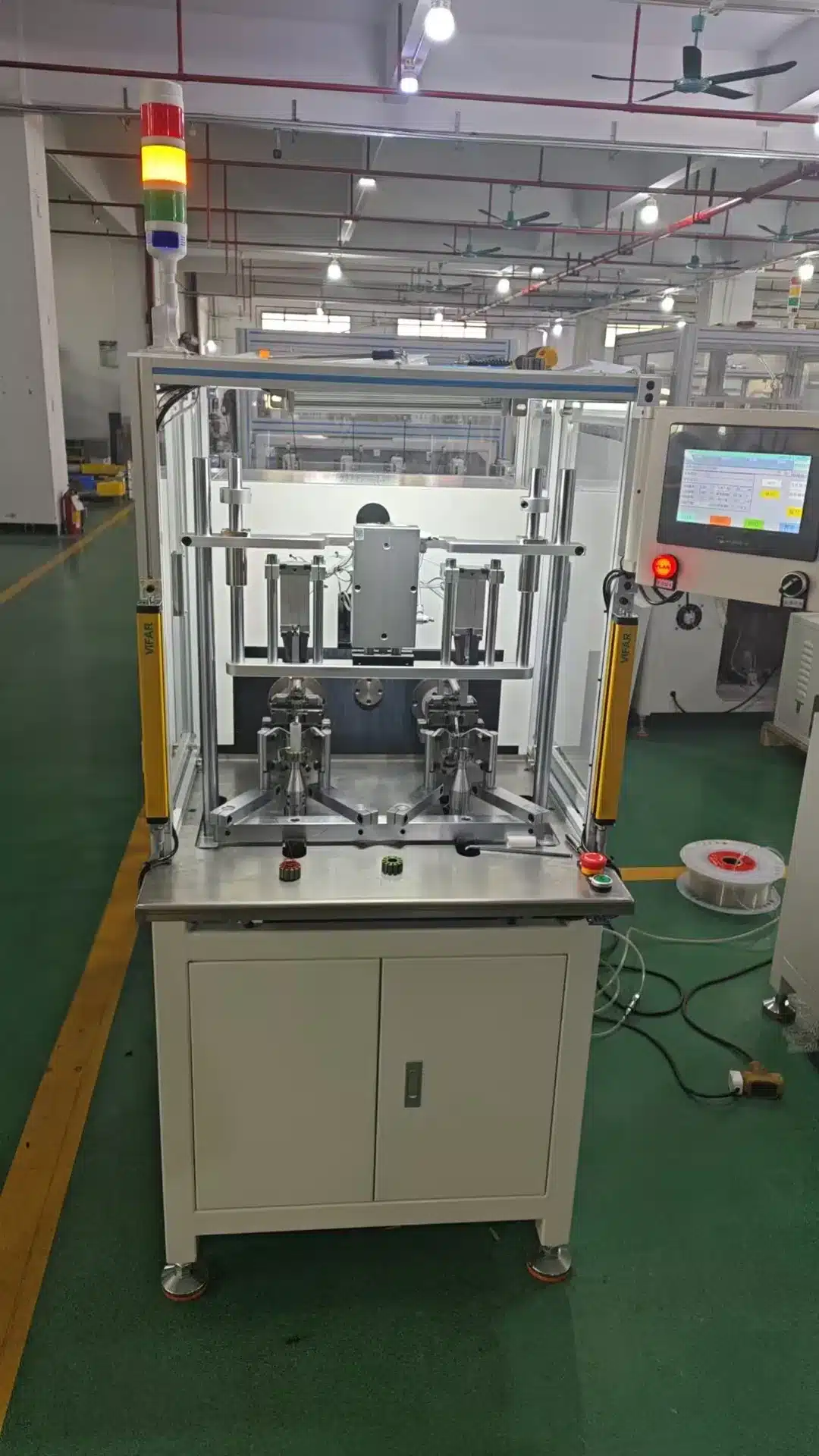
I. Core Winding Equipment: Flying Fork Winding Machine
The flying fork winding machine is the mainstream equipment for drone motor stator winding. Its working principle is that a high-speed rotating flying fork works in conjunction with components such as the die head and guard plate to accurately insert the enameled wire into the stator slot. This equipment is suitable for external rotor brushless motors (slots facing outwards), and is especially suitable for high-precision applications such as drones and model aircraft.
1. Equipment Selection Considerations
Workstation Configuration
Dual-station: Suitable for small-batch production or winding of fine wire diameters (e.g., below 0.3mm), reducing the risk of wire breakage.
Four-station and above: Suitable for mass production, capable of winding multiple stators simultaneously, improving efficiency (e.g., four-station equipment increases speed by 4 times), but wire diameter matching must be ensured to avoid wire breakage.
Drive System
Servo motor + high-precision drive controller: Meets precision wiring requirements (e.g., DJI drones), ensuring winding accuracy and stability.
Closed-loop tension control system: Monitors and adjusts wire tension in real time to prevent wire breakage or coil loosening.
Core Components
Uses internationally renowned brand motors, lead screws, guide rails, etc., ensuring equipment durability under high-speed operation.
Redundant design (e.g., dual-motor drive) enhances reliability.
Automation Functions
Automatic clamping, winding, and cutting: Improves production efficiency and reduces operational complexity.
IoT remote monitoring: Monitors winding parameters in real time, automatically alarming and adjusting in case of abnormalities.
II. Production Details: Full-Process Control from Design to Quality Inspection
1. Pre-Winding Design
Wire Routing Planning: Design a simple wiring and routing method to facilitate wire cutting and connection, reducing winding errors.
Parameter Preset: Import a dedicated winding program (e.g., number of turns, speed) according to the stator model, or automatically set parameters through artificial intelligence algorithms.
2. Equipment Debugging and Operation
Tension Control:
The tension must be uniform, avoiding excessive (wire breakage) or insufficient (loose coil).
Refer to the wire diameter and tension correspondence table.
Speed Control:
Start winding slowly, gradually increasing the speed after stabilization to avoid skipped wires or pin collisions.
The maximum speed must comply with the equipment manual.
Wire Arrangement Accuracy:
Use laser-guided or magnetic levitation wire arrangement technology to ensure tight wire arrangement.
Introduce an adaptive wire arrangement algorithm to automatically adjust the strategy according to wire characteristics.
3. Multi-wire Winding Process
External Winding (Flying Fork Winding Machine):
30 wires can be wound simultaneously for wire diameters below 0.3mm. Single/double station equipment is required.
Avoid exceeding wire diameter limits, which would reduce the number of strands wound simultaneously (e.g., 0.5mm wire diameter only supports 10 strands).
Internal Winding (Pin Type Winding Machine):
Commonly used for double and triple wire winding. Prevention of wire scraping or breakage is necessary.
Suitable for stator structures with slots facing inwards.
4. Quality Inspection and Post-processing
Brine Test:
After winding, the coil is immersed in brine to test insulation performance and prevent performance degradation or damage.
Historical Data Recording:
Record winding parameters and effects to provide a basis for process optimization.
Quick Mold Changeover:
Shorten production changeover time and improve equipment utilization.
UAV motor stator winding requires a flying fork winding machine as the core, combined with a precision drive system, closed-loop tension control, and automation functions to ensure winding accuracy and efficiency. In terms of production details, strict control over tension, speed, and wire winding accuracy is necessary, and quality must be ensured through quality inspection methods such as salt water testing. Selecting dual-station to four-station equipment based on production scale, balancing cost and efficiency, is key to enhancing competitiveness.

What type of winding machine is used for winding the stator of a drone motor? What are the production details? Vacuz has provided a brief explanation above, and we hope this information is helpful!