














The application of automated production lines for motor rotors not only improves production efficiency but also enhances quality, resulting in a more standardized, tidy, and clean workshop. So, how do automated production lines for motor rotors adapt to customer production needs? What is the typical production cycle time? Below, Vacuz will give you a brief introduction!
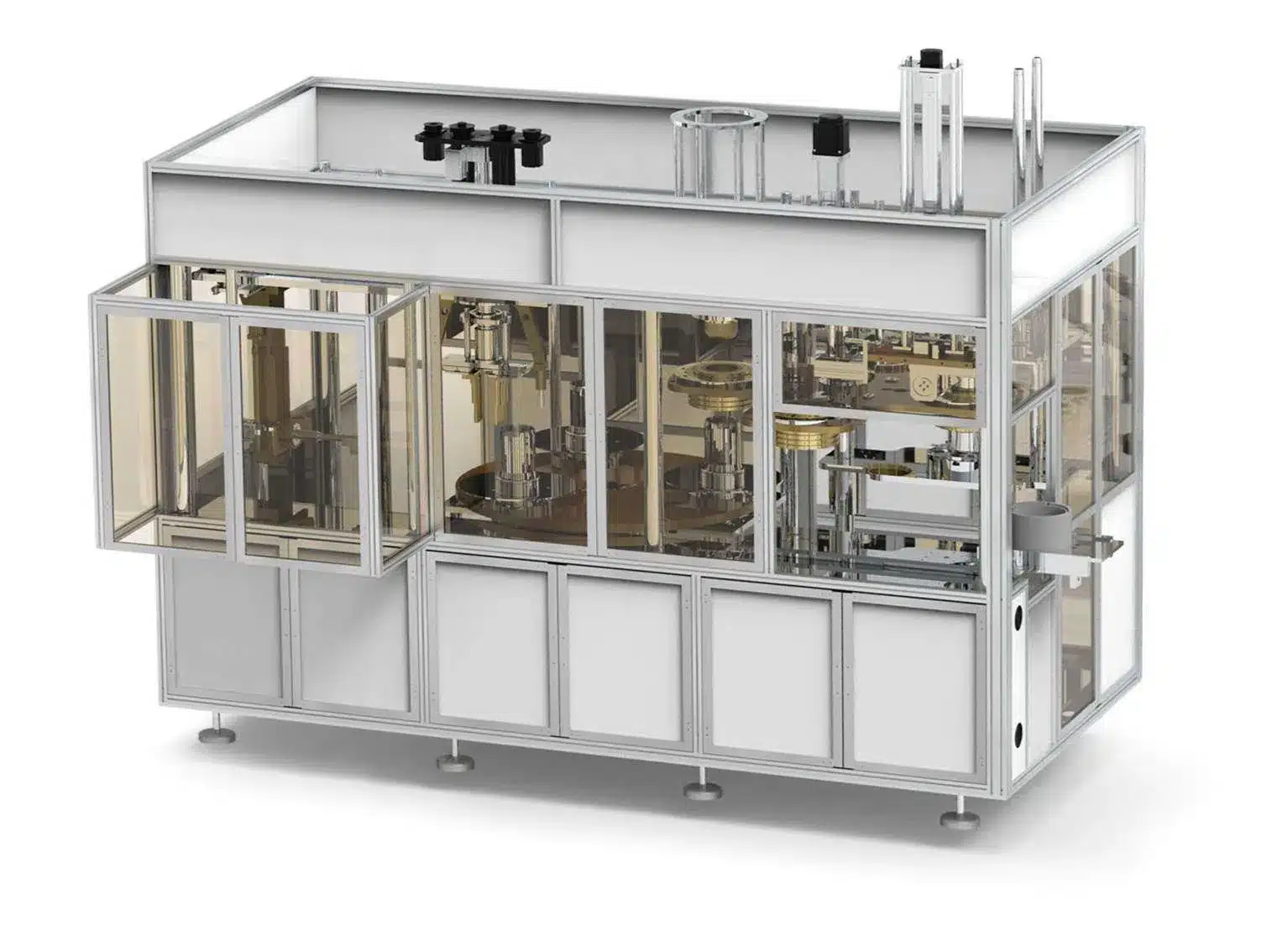
Methods by which automated production lines for motor rotors adapt to customer production needs:
1. Modular and Flexible Design:
Adaptive Conveyor Track: The track spacing is adjusted via a servo motor, allowing for the adaptation of rotors from Φ80mm to Φ150mm within 30 seconds, covering models with diameter spans ≥3 times, meeting the production needs of rotors of different sizes.
Quick-Change Fixtures: A robotic arm that automatically changes fixtures using barcode scanning to retrieve parameters reduces changeover time to within 15 minutes, supporting mixed-model production and quickly adapting to production switching between different rotor models.
Adjustable Pressure Magnet Bonding Machine: Equipped with a servo system and vision positioning module, it adapts to magnets with thicknesses from 2mm to 8mm, automatically correcting bonding position deviations to meet the bonding needs of magnets of different thicknesses.
2. Intelligent Technology Integration:
**Material Loading:** A laser diameter gauge automatically identifies the rotor diameter and shaft length, transmitting the data in real-time to the central control system for precise loading.
**Post-Magnet Bonding Inspection:** An industrial camera images the rotor surface, and an AI algorithm detects the magnet’s positional accuracy and bonding strength, ensuring high-quality bonding.
**Dynamic Balancing Test:** The equipment automatically calls upon the corresponding balancing standard, rejecting out-of-tolerance products and optimizing the clamping force to guarantee the rotor’s dynamic balance performance.
**Closed-Loop Data Control:** Sensors collect parameters such as winding tension and speed in real-time, feeding them back to the PLC system for dynamic adjustment of process parameters (e.g., speed reduction and pressure adjustment when tension exceeds limits), achieving accurate control of the production process.
**Central Control System:** Processing procedures and equipment parameters for different rotor specifications are pre-entered. Operators can access these parameters with a single click via the human-machine interface, completing the switch from a new energy vehicle drive motor rotor (Φ120mm) to a household appliance motor rotor (Φ60mm) within 15 minutes, increasing efficiency by 16 times.
Modular Process Library: Supports parametric programming, such as calling process parameters for new models via barcode scanning, reducing debugging time from 3 days to 2 hours and accelerating the introduction of new products.
3. Versatility and Compatibility Design:
Model Compatibility: A single line must be compatible with ≥8 models, with a diameter span of ≥3 times (e.g., Φ50mm – Φ150mm), meeting diverse customer production needs.
Modular Fixtures: Supports rapid switching between multiple models, increasing equipment utilization by 40% and reducing equipment idle time.
AGV/RGV Flexible Conveying: Dynamic path planning enables mixed-flow production, improving logistics efficiency by 25% and enhancing the overall operating efficiency of the production line.
4. Customized Services:
Parametric Programming: Reduces manual debugging time, suitable for high-volume, low-variety production, meeting the production needs of specific customer products.
Buffer Station Design: Buffer stations are set up before key processes, reducing downtime by 60% and improving the stability and reliability of the production line.
Reserved Capacity Flexibility: Reserves 20% expansion space, with upgrade costs ≤30% of the original investment, facilitating capacity expansion according to market demand. Production Cycle of an Automated Motor Rotor Production Line:
The manufacturing cycle for an automated motor rotor production line typically takes about 75 days. The specific process is as follows:
Design Phase: Approximately 15 days. This phase involves overall design based on customer needs and the functional requirements of the production line.
Materials and Accessories Procurement Phase: 10-20 days. Procurement of required materials and accessories is based on the design plan. Procurement time is affected by accessory availability and the procurement process.
Production Assembly Phase: Requires 20 days. The procured materials and accessories are assembled to form the various modules and equipment of the automated production line.
Line Commissioning Phase: Requires 10-20 days. Overall commissioning of the assembled automated production line is conducted to ensure that all modules and equipment work together to meet production requirements.

How does an automated motor rotor production line adapt to customer production needs? What is the typical production cycle? Vacuz has provided a brief explanation above. We hope this information is helpful!
 English
  Spanish
  Portuguese
  Italian
  German
  French
  Russian
  Turkish
  Polish
  Ukrainian
  Japanese
  Korean
  Chinese (Taiwan)
  Chinese (China)