













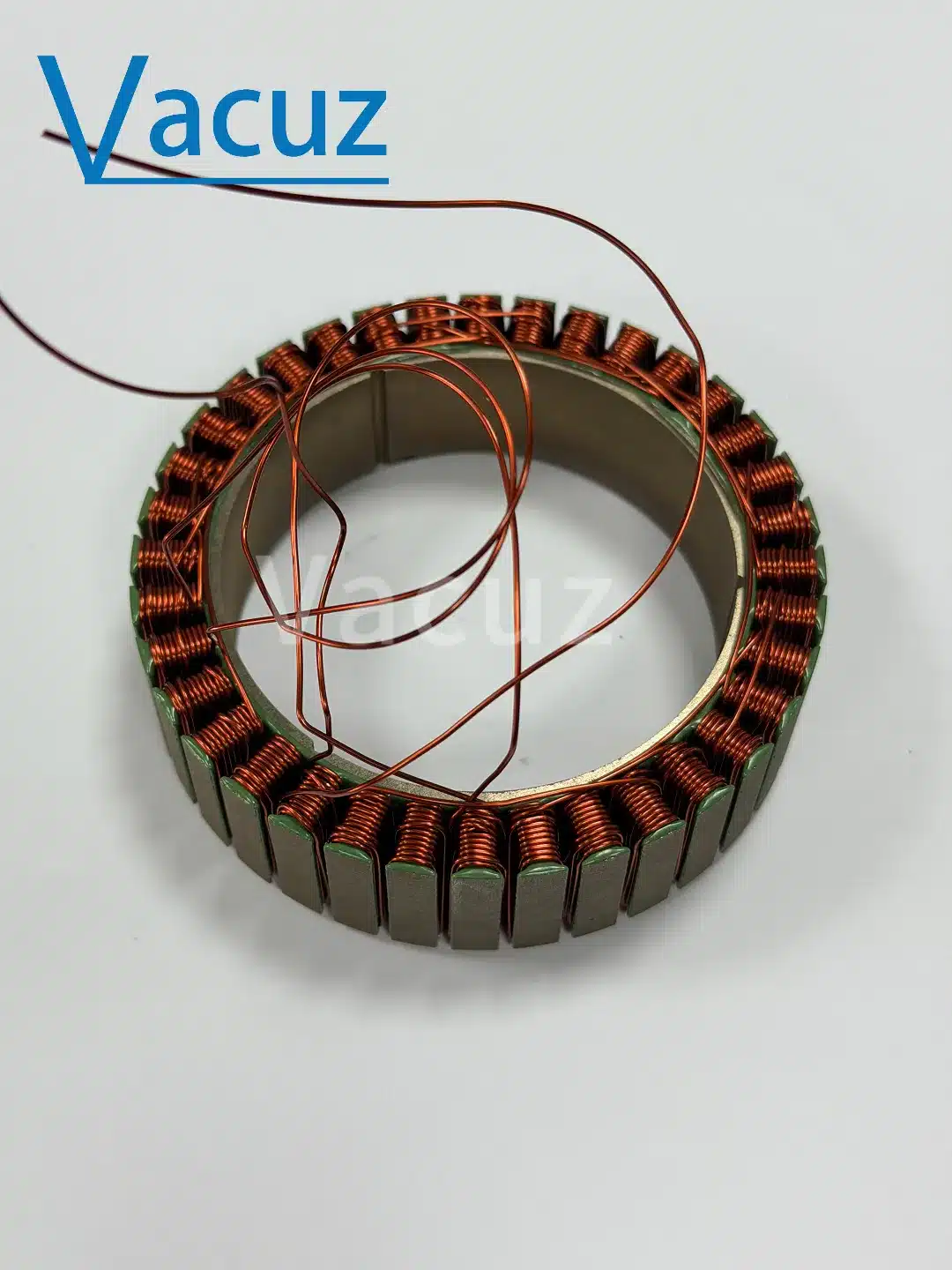
The requirements for motor configuration in a brushless motor stator winding machine must revolve around stator characteristics, winding process requirements, and customer customization needs. Only with a properly configured motor component can stable and reliable winding operation be ensured. Specific requirements and strategies for meeting customer customization needs are as follows, which Vacuz will briefly introduce:

I. Core Requirements for Motor Configuration in a Brushless Motor Stator Winding Machine
1. Matching of Power Performance and Precision
High-Speed Servo Motor: For fine wires (e.g., 0.08-0.3mm), it must support ultra-high-speed mode (≥3500 rpm), while for thicker wires (1.0-1.3mm), it must automatically switch to a low-speed range (800-1500 rpm), eliminating the risk of wire breakage through a dynamic PID algorithm.
Zero Backlash Torque Motor: Transmission error must be <0.005mm. Combined with a nano-level grating ruler feedback system, it achieves a winding shape accuracy of ±3μm, ensuring a tight and consistent coil arrangement.
1. Lightweight Transmission Components: Utilizing carbon fiber wire guides and magnetic levitation rails, acceleration is increased to 2G, with a positioning error of ±0.008mm, reducing the impact of mechanical shock on the wire.
2. Tension Control and Material Compatibility
Closed-Loop Tension Adjustment System: Copper wire tension range 5-50N, aluminum wire automatically reduced by 15%, achieving ±0.5N accuracy through real-time feedback from strain gauges, preventing wire damage or breakage.
Sudden Wire Breakage Response: The electromagnetic brake must lock the wire reel within 10ms to prevent wire scattering or equipment damage.
Material Compatibility: For different wire materials such as copper, aluminum, and iron, an adjustable tension parameter controller is required to ensure winding stability.
3. Mold and Tooling Flexibility
Parameterized Mold Library: Automatically matches mold type based on slot spacing and stack thickness, changeover time ≤30 minutes, supporting rapid switching between multiple stator specifications.
Adjustable shim design: As in customized customer cases, 5mm and 10mm shims enable universal tooling for stators with 25, 20, and 15 stack heights, reducing mold costs.
Self-cleaning nozzle: Built-in micro air blowing device automatically removes copper shavings during winding, reducing scratch rate by 90% and improving winding quality.
4. Wire routing and path planning
3D wire routing trajectory algorithm: Generates a path with intelligent 30% speed reduction at corners, achieving a wire overlap rate of <0.1%, avoiding wire overlap or uneven gaps.
S-shaped acceleration/deceleration curve: Based on fifth-order polynomial planning of motion trajectory, the acceleration change rate transitions smoothly, reducing mechanical impact by 40% and extending equipment life.
II. Key strategies for meeting customer customization needs
1. Needs analysis and parameter matching
Accurate acquisition of stator parameters: Clearly define the stator model, power, slot direction, outer diameter, inner diameter, stack thickness, wire diameter, and other parameters provided by the customer as the basis for customization.
1. **Process Requirements Breakdown:** Based on the customer’s specific requirements for winding speed, accuracy, and tension control, the design is broken down into sub-modules such as motor speed, tension system, and wire arrangement algorithm.
2. **Modular and Scalable Design:**
Mechanical Structure Modularization: The winding machine is divided into power module, transmission module, and mold module, facilitating independent upgrades or replacements.
Electrical System Standardization: Adopting internationally recognized interfaces and protocols, it supports rapid replacement of components such as servo motors and drivers, reducing later maintenance costs.
3. **Intelligent and Automated Integration:**
Fully Automated Winding System: Integrates automatic loading and unloading, automatic wire changing, and automatic detection functions, reducing manual intervention.
Machine Vision Quality Inspection: Utilizes AI image recognition technology to detect wire harness flatness (accuracy 0.02mm), providing real-time feedback to adjust wire arrangement parameters, ensuring winding quality meets customer standards.
4. **Technical Support and After-Sales Service:**
Customized Training Programs: Provides tiered training from basic operation to advanced maintenance based on the skill level of the customer’s operators, shortening the equipment mastery cycle.
Rapid Response Mechanism: A 24/7 technical support team is established to provide solutions or on-site service within 2 hours for customer feedback issues (such as tension fluctuations and frequent wire breakage).
Regular Upgrade Service: Software upgrades or hardware modifications are provided based on changes in customer production needs (such as adjustments to stator parameters for new products) to extend equipment lifespan.

What are the requirements for motor configuration in a brushless motor stator winding machine? How can it meet customized customer needs? Vacuz has provided a brief explanation above; we hope this information is helpful!
 English
  Spanish
  Portuguese
  Italian
  German
  French
  Russian
  Turkish
  Polish
  Ukrainian
  Japanese
  Korean
  Chinese (Taiwan)
  Chinese (China)