














Stator winding for brushless motors is an indispensable process. Many people think that simply winding the wire is enough, but the wiring arrangement and tightness requirements are actually crucial. So, what causes poor wiring in a motor stator winding machine? What are the requirements for the machine and its components? Vacuz will give you a brief introduction below!
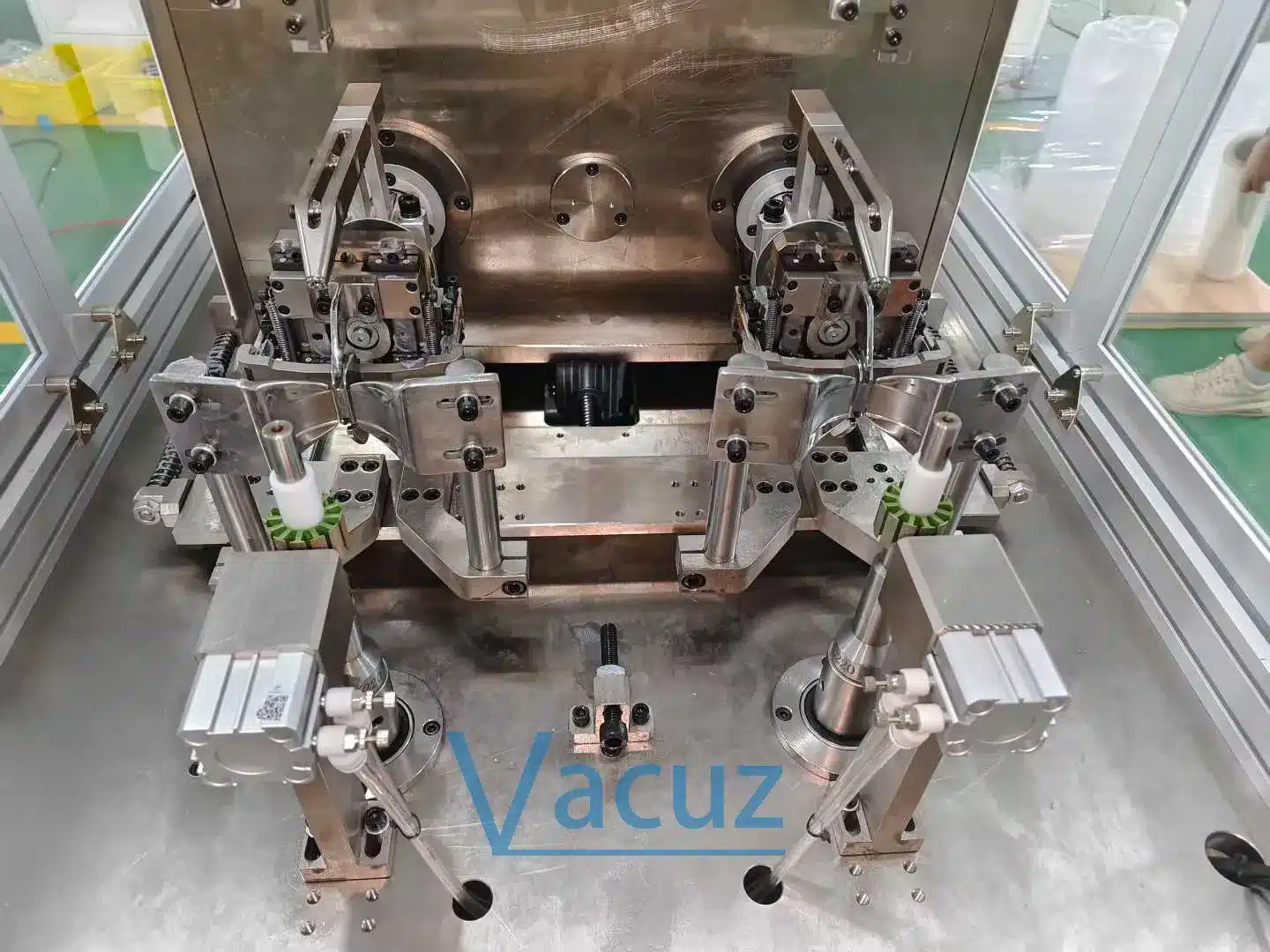
I. Main Reasons for Poor Wiring
1. Insufficient Equipment Configuration
Low Precision of Core Components: Insufficient precision in key components such as the servo motor, guide rail, lead screw, cylinder, and wire nozzle can lead to wiring position deviations or unstable movement.
Tension Control Failure: Incorrect tensioner settings or improper adjustment can cause the enameled wire to be too tight (prone to breakage) or too loose (loose wiring).
Wounding Speed Mismatch: Excessive machine speed exceeding the wire diameter’s capacity can cause wiring malfunctions.
2. Machine Stability Issues
Base and Frame Defects: Inadequate materials or manufacturing processes can cause vibration during high-speed operation, affecting wiring accuracy.
Environmental Interference: Uneven installation ground or the presence of vibration sources or high-temperature equipment nearby can interfere with machine stability. 3. Debugging and Operation Issues
Insufficient debugging personnel experience: Incorrect parameter settings (e.g., winding speed, tension value) or non-standard debugging procedures lead to uneven wire laying.
Insufficient mold precision: Rough machining of the stator core, frame, and mold, resulting in burrs or positioning deviations, scratching the enameled wire or affecting the wire laying path.
4. Wire Material and Process Issues
Poor wire quality: Inconsistent wire diameter or damaged insulation layer leads to uneven wire laying resistance.
Complex winding method: Unreasonable wire path design increases the risk of wire friction or crossing.
II. Core Requirements for Machines and Components
1. High-precision transmission system
Guide rails and lead screws: A combination of ball screws and linear guide rails is used. The positioning error must be controlled within ±0.01mm to ensure the stability of the wire laying device during high-speed movement.
Servo motors: Rated speed not less than 3000RPM, direct drive technology is preferred to eliminate mechanical transmission errors, and the spindle speed can exceed 5000RPM.
2. Dynamic Response Optimization
Wire Guide Structure: Finite element analysis reduces inertial mass, increasing acceleration to over 1.5G to meet high-speed start-stop requirements.
Vibration Suppression: Integrated vibration suppression algorithm, injecting notch filters at key frequency points to reduce the impact of resonance on speed stability.
3. Intelligent Tension Control
Tension Sensor: Real-time monitoring and adjustment of winding tension; copper wire tension controlled within 0.5-5N, aluminum wire within 0.3-3N.
Closed-Loop Feedback System: Automatically optimizes the tension curve based on wire material, diameter, and winding speed to prevent wire breakage or loosening.
4. High-Rigidity Die and Positioning Device
Die Material: Utilizes high-strength materials such as alloy steel to ensure no deformation during winding.
Machining Accuracy: Die surface is free of protrusions and burrs; the positioning device and wire guide device fit tightly together to avoid wire scraping or path deviation.
5. Environmental and Process Control
Constant Temperature and Humidity Workshop: Temperature controlled at 20±2℃, humidity controlled at 50±5%, to prevent softening of the enameled wire insulation.
Vibration Reduction and Sound Insulation: Install vibration damping pads and soundproof covers to control vibration amplitude to ≤0.02mm, improving wire routing accuracy.
6. Real-time Monitoring and Fault Prevention
Machine Vision Inspection: Deploy high-speed cameras and image processing algorithms to monitor wire routing status in real time, achieving a defect detection accuracy rate of ≥99.5%.
Multi-Source Sensor Fusion: Integrate tension, temperature, and vibration sensors, using machine learning to predict equipment faults (such as tensioner wear).
7. Operator Skills Training
Regular Training: Strengthen equipment operation, parameter adjustment, and troubleshooting skills to ensure wire routing spacing tolerance is strictly controlled within ±0.03mm.
Quality Awareness Education: Establish a process database to support rapid parameter matching and reduce human error.

What are the reasons for poor wire routing on a motor stator winding machine? What are the requirements for the machine and components? The above provides a simple explanation of Vacuz, and we hope this information will be helpful!
 English
  Spanish
  Portuguese
  Italian
  German
  French
  Russian
  Turkish
  Polish
  Ukrainian
  Japanese
  Korean
  Chinese (Taiwan)
  Chinese (China)