















In brushless stator winding machines, the wire diameter significantly affects winding speed, equipment configuration, production efficiency, and the selection requirements for enameled wire. Inappropriate selection or poor wire quality will impact winding quality and results. So, what are the differences between different wire diameters in brushless stator winding machines? What are the requirements for the enameled wire? Below, Vacuz will provide a brief introduction!
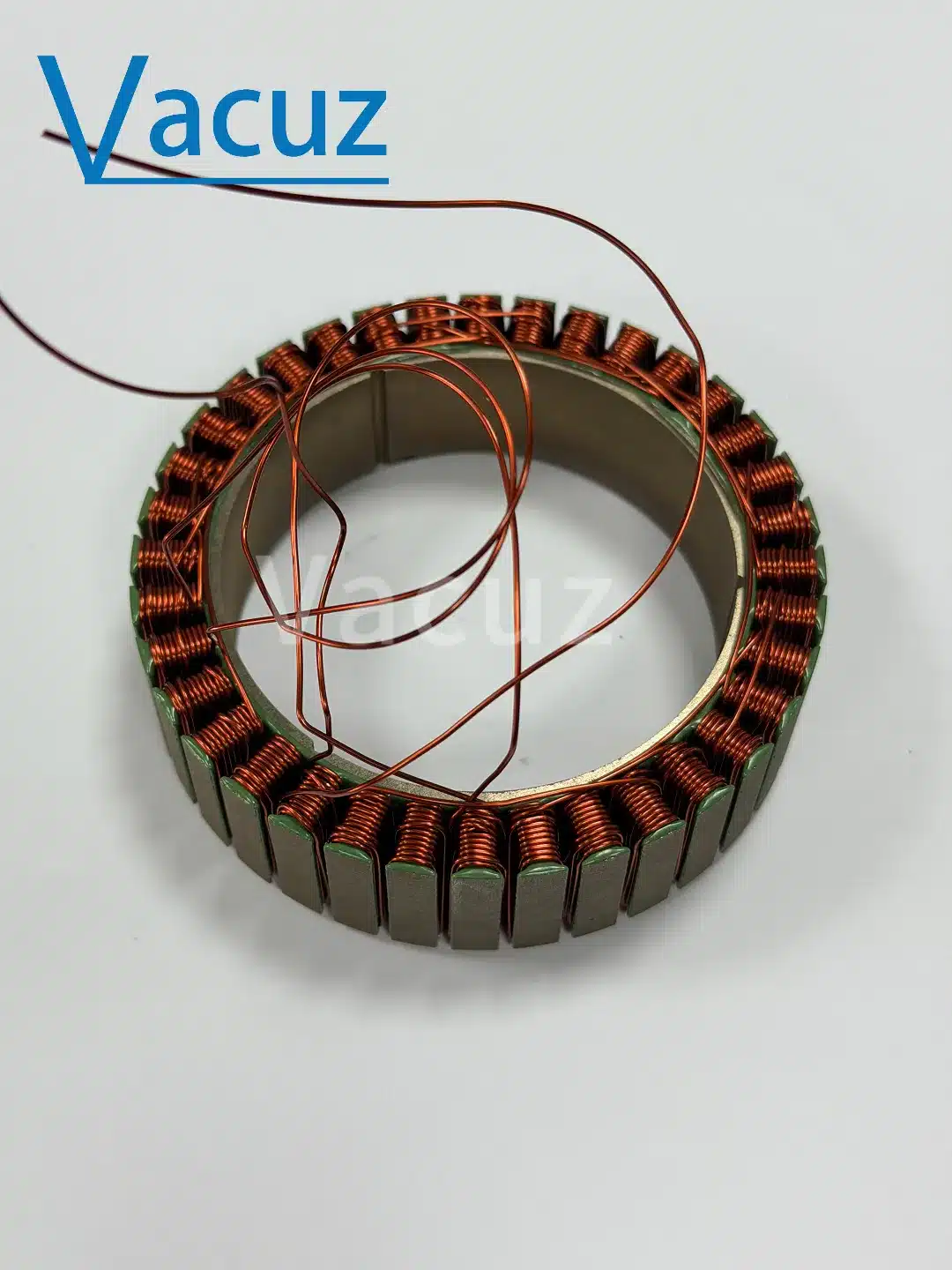
I. Differences Arising from Different Wire Diameters:
1. Winding Speed:
Fine Wire Diameter: For example, 0.1-0.2mm wire diameter, the inner winding speed can reach 800-1000 RPM, and the outer winding speed can reach 2800+ RPM. Fine-diameter enameled wire has more turns, potentially requiring higher winding speeds to improve production efficiency.
Coarse Wire Diameter: For example, around 1.0mm wire diameter, the speed may only reach between 100-300 RPM. Coarse-diameter enameled wire may place higher demands on the equipment during winding, increasing the difficulty and precision challenges, resulting in relatively lower winding speeds.
2. Equipment Configuration:
Fine wire diameter: High-speed winding machines are typically chosen to improve winding efficiency.
Coarse wire diameter: A tension control system and a precision winding machine are required to ensure the tightness and stability of the coil winding.
3. Production Efficiency:
Fine wire diameter: Due to its high winding speed and large number of turns, it is suitable for applications requiring fine coils, such as small or micro motors, improving motor output efficiency and operating speed.
Coarse wire diameter: The winding speed is slower, but it is suitable for high-temperature and high-load environments, such as high-power motors, capable of handling greater power, reducing energy loss, and improving motor efficiency.
4. Multi-wire winding:
Fine wire diameter: For example, 0.2-0.3mm wire can be wound up to 30 strands in parallel. Compared to winding a single thick wire, multi-wire winding is more advantageous and easier to implement.
Coarse wire diameter: When multi-wire winding, the speed decreases as the number of copper wires increases, requiring gradual speed adjustments to achieve a suitable state.
II. Requirements for Enamelled Wire
1. Material Selection:
Copper Enamelled Wire: Due to its excellent conductivity and corrosion resistance, it is the choice for most brushless motors.
Aluminum/Iron Wire: In specific situations, such as when weight is limited or higher mechanical strength is required, aluminum or iron wire may be considered. However, aluminum wire has slightly inferior conductivity, while iron wire, due to its superior hardness and strength, is suitable for some special applications.
2. Performance Evaluation:
Heat Resistance: The stator winding temperature of the motor can reach 120℃-180℃ during operation. Therefore, the enamelled wire must maintain stable insulation performance in high-temperature environments (such as above 150℃) to avoid insulation aging or peeling.
Conductivity: As the medium for current transmission, the conductivity of the enamelled wire directly affects the efficiency and energy consumption of the motor. Enamelled wire with excellent conductivity should be preferred to reduce energy loss during transmission.
Insulation Performance: The insulation layer of the enamelled wire must withstand 1.5-2 times the rated voltage of the motor to prevent high-voltage breakdown or leakage. Excellent insulation performance is crucial for preventing current leakage, avoiding electric shock accidents, and short circuit faults.
3. Specification Matching:
Wire Diameter: Select an appropriate enameled wire diameter based on the motor’s power, efficiency, temperature resistance, and other performance requirements, as well as the winding machine’s technical specifications and production capacity. Excessively thick wire increases winding difficulty and slot fill factor, while excessively thin wire leads to insufficient current carrying capacity.
Insulation Thickness: Determine the insulation thickness based on the motor’s voltage level and operating environment. It must ensure good insulation performance while avoiding excessive thickness that would increase wire diameter and cost.
4. Special Requirements:
Abrasion Resistance: During high-speed winding, friction between the enameled wire and the guide wheel and die can easily cause the wire diameter to thin or the insulation layer to peel off. Therefore, the surface of the enameled wire must have an abrasion-resistant coating to withstand friction and vibration during winding and prevent insulation damage.
Storage Conditions: Store in a dry, light-protected environment to prevent insulation aging. The spool should be placed horizontally to prevent wire deformation or localized stress.
What are the differences between brushless stator winding machines with different wire diameters? What are the requirements for enameled wire? Vacuz has provided a simple explanation above, and we hope this information is helpful!
 English
  Spanish
  Portuguese
  Italian
  German
  French
  Russian
  Turkish
  Polish
  Ukrainian
  Japanese
  Korean
  Chinese (Taiwan)
  Chinese (China)