














The assembly of brushless motor rotors requires specialized automated assembly equipment. These machines, combined into production lines, improve the efficiency and quality of rotor assembly. So, what are the techniques for automated assembly of brushless motor rotors? How should the production line be planned? Vacuz will give you a brief introduction below!

I. Core Production Techniques:
1. Selection of High-Precision Automated Equipment
Key Equipment: Utilizing servo press-fitting equipment (magnet press-fitting), high-precision winding machines (winding process), fully automatic dynamic balancing machines (dynamic balancing correction), and laser welding machines (welding process), etc., ensures the assembly accuracy of core components (such as magnets, iron cores, and shafts). For example, servo press-fitting equipment can achieve a tight fit between the magnet and the iron core, preventing loosening or misalignment.
Equipment Configuration: The frame should be made of high-strength metal (such as stainless steel), paired with precision ball screws, low-backlash guides, high-response cylinders, and servo drive systems to reduce mechanical vibration and transmission errors, improving equipment stability.
2. Modular and Flexible Design
Rapid Changeover: Modular design (e.g., replaceable fixtures and tooling plates) enables rapid switching between different rotor specifications, reducing changeover time (e.g., from 2 hours to 30 minutes).
Compatibility Expansion: Production lines need to support multi-variety, small-batch production. For example, by adjusting program parameters or replacing some modules, compatibility with rotors of different diameters and pole numbers can be achieved.
3. Online Monitoring and Feedback Control
Critical Process Monitoring: Online monitoring equipment (e.g., laser sensors, tension sensors, dynamic balancing instruments) is installed in processes such as magnet bonding, winding tension, and dynamic balancing to monitor parameters in real time and feed them back to the control system. For example, if the winding tension exceeds the set range (e.g., ±5%), the system automatically adjusts the winding machine speed or tension controller parameters.
SPC Process Control: Statistical process control is implemented for critical processes. Process capability is analyzed through control charts to promptly identify and correct deviations, ensuring product consistency.
4. Error-Proofing and Mistake-Proofing Design
Mechanical Error-Proofing: Guide grooves or positioning pins are installed at the magnet insertion station to prevent incorrect magnetic pole orientation; force-displacement monitoring is used in the pressing process, and the machine immediately stops and alarms if the pressure or displacement exceeds the threshold.
Visual Error-Proofing: An AI visual inspection system is introduced to identify magnet polarity, winding arrangement, and surface defects (such as scratches and cracks), with an accuracy rate of up to 99.9%.
5. Process Parameter Optimization
Magnet Pressing: A segmented pressing process is adopted, pre-pressing to 50% of the stroke before full pressing to reduce magnet breakage caused by stress concentration.
Winding Process: The winding speed and tension are adjusted according to the wire diameter and number of turns to avoid wire breakage or wire stretching deformation.
Dynamic Balancing Correction: Parameters are adjusted three times using a fully automatic dynamic balancing machine: initial coarse calibration, intermediate fine calibration, and final micro-calibration, improving the smoothness of motor operation.
II. Production Line Planning:
1. Production Line Layout Principles
U-shaped or Straight Line Layout: The layout form is selected according to site conditions. U-shaped layouts are suitable for small-batch, multi-variety production, reducing material handling distances; straight-line layouts are suitable for large-batch, single-variety production, facilitating assembly line operations.
Smooth process integration: Equipment is arranged according to the rotor assembly flow (automatic feeding → automatic dispensing → automatic magnet insertion → automatic shaft pressing → automatic balance block pressing → automatic fan pressing → automatic bearing pressing → automatic magnetic measurement → automatic rotor balancing → automatic unloading) to ensure short material flow paths and avoid cross-interference.
Humanized operation design: The height of the equipment control panel and the placement of tooling fixtures are ergonomically designed to reduce operator fatigue; emergency stop buttons and safety light curtains are provided to ensure operational safety.
2. Equipment Configuration and Expandability
Core equipment list: Includes automatic feeding machine, dispensing machine, magnet insertion machine, servo press machine, dynamic balancing machine, testing instrument, etc. The number of equipment is configured according to production capacity requirements, with a 20% redundancy.
3. Scalability Design: The production line must support future upgrades, such as adding visual inspection stations, automated packaging lines, or integration with the MES system to achieve real-time production data collection and analysis.
4. Staffing and Training
Job Division: Establish positions such as operators, quality inspectors, and technicians, with a staffing ratio of 1:5.
Training System: Develop standardized operating instructions, clearly defining the operating steps, quality standards, and precautions for each process; conduct regular skills training and assessments to ensure operators meet skill standards.
5. Quality Traceability and Management System
Full-Process Traceability: Establish an MES system to record production data for each rotor (such as equipment number, operator, process parameters, and test results), achieving full traceability from raw materials to finished products.
Data Analysis and Improvement: Analyze production data through SPC to identify improvement points (e.g., a defect rate of >1% for a certain process for 3 consecutive days), and continuously optimize the process using the PDCA cycle. 5. Environmental and Material Management
Clean Production Environment: The assembly workshop must maintain cleanliness, with temperature controlled between 20℃ and 25℃ and humidity between 40% and 60%, to prevent impurities from entering the rotor and affecting its performance.
High-Accuracy Material Management: Strict dimensional and performance testing is conducted on critical materials. An advanced warehouse management system is employed to prevent material mixing and expired use.
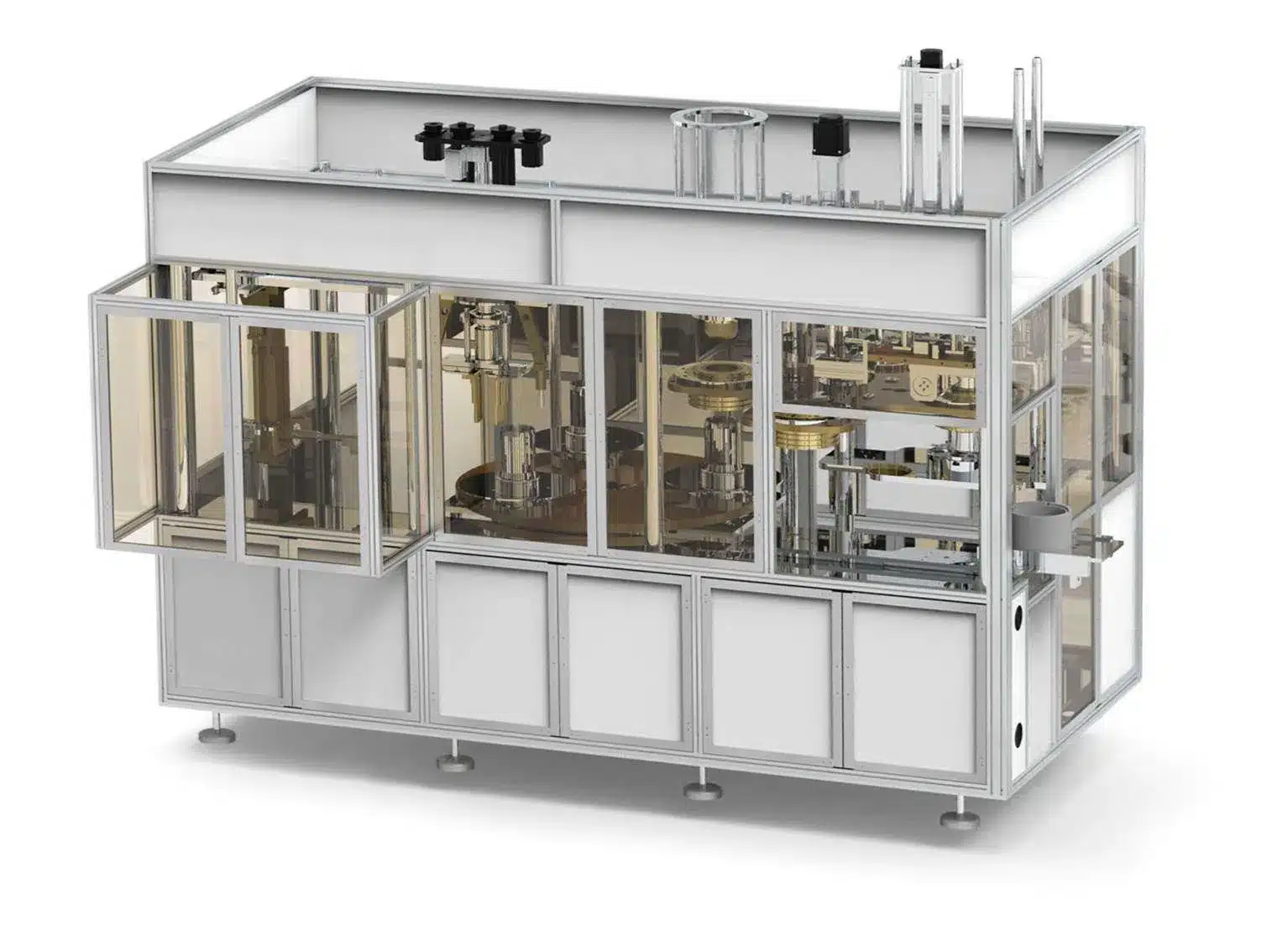
What are the techniques for automated assembly of brushless motor rotors? How should the production line be planned? Vacuz has provided a simple explanation above; we hope this information is helpful!
 English
  Spanish
  Portuguese
  Italian
  German
  French
  Russian
  Turkish
  Polish
  Ukrainian
  Japanese
  Korean
  Chinese (Taiwan)
  Chinese (China)