















The stator winding process for brushless motors is relatively complex and can be completed using a specialized winding machine. Regardless of the type of winding machine, it requires customization of the machine and molds according to customer requirements, and necessitates professional technical training in debugging and changeover procedures. So, how is a brushless motor stator winding machine changedover and debugged? What maintenance measures are needed? Below, Vacuz will give you a brief introduction!

I. Changeover and Debugging Steps and Core Requirements
1. Safe Shutdown and Power Disconnection
Before debugging, the machine must be completely stopped and the power supply disconnected to prevent accidental start-up or electric shock risks.
2. Disassembling the Old Tooling
Carefully remove the original molds, wire nozzles, tensioners, and other components to avoid damaging the tooling or equipment.
3. Cleaning and Inspection
Thoroughly clean the winding machine’s worktable, spools, felt, guide rollers, wire nozzles, etc., removing waste wire ends, impurities, and foreign objects.
Inspect the wear condition of transmission components (such as the motor, bearings, lead screw, and guide rails), and lubricate or replace them if necessary.
4. Install New Tooling
Select matching molds, wire nozzles, and tensioners according to the new stator specifications, ensuring secure installation and accurate positioning.
The molds must perfectly fit the stator, and the polishing and precision must meet requirements to prevent wire scratching or pin collisions.
5. Program Import and Debugging
Create or import a winding program based on the stator winding diagram. Manually adjust the wire nozzle and pin bar paths to ensure no collisions or scratches.
Perform a no-load test, observing changes in parameters and component coordination, confirming no abnormal sounds or vibrations.
6. Trial Run with Wire
Perform a trial run in manual mode, gradually checking the winding, coil winding, wire arrangement, indexing, and wire cutting processes to ensure the wire nozzle and pin bar operation meet requirements.
Perform a slow-speed automatic run, winding several stators before conducting a brine test to confirm that the leakage current value meets standards.
7. Parameter Optimization and Storage
Adjust parameters such as tension, speed, and wire arrangement spacing based on the trial run results until the winding effect meets requirements.
Store the optimized program and number it for easy future retrieval.
Core Requirements:
1. Compatibility: The tooling model must be strictly matched with the winding machine to avoid compatibility issues.
2. Accuracy: The positioning of the mold and winding machine must be accurate, with an error ≤ ±0.05mm.
3. Flexibility: The equipment must support rapid changeover of multiple stator models to reduce downtime.
4. Safety: The operation process must strictly adhere to safety procedures to prevent accidents.
5. Maintainability: The equipment design must facilitate cleaning, lubrication, and component replacement to reduce maintenance costs.
II. Maintenance Measures and Implementation Points
1. Daily Cleaning and Inspection
Workbench: Clean waste thread ends, impurities, and dust before leaving get off work each day. A blower can be used to assist in cleaning.
Key Parts: Check the spool, felt, guide roller, and thread nozzle for foreign objects or sharp objects, and remove them promptly to prevent thread breakage.
1. Electrical Components: Check the power supply voltage, wiring, relays, etc., to ensure normal power supply and no air leaks in any cylinders.
2. Transmission Component Lubrication:
Regularly lubricate the motor, rolling bearings, lead screw, guide rails, etc., to ensure smooth operation.
Pay special attention to lubrication of the die tongue on the flying fork winding machine to prevent spring jamming.
3. Tensioner Maintenance:
Check that the tensioner components are operating normally and that the tension range is within the specified values.
Remove dust from the tensioner surface and perform routine maintenance on precision parts.
4. Equipment Stability Check:
Observe the equipment for significant vibration during operation. If vibration is present, it may be due to loose casters or bottom screws; tighten them promptly.
Regularly check the frame’s stability to ensure there is no loosening or deformation.
5. Regular Deep Maintenance:
Weekly: Clean key components such as guide wheels and tension sensors, and check for wear on transmission components.
Monthly: Perform comprehensive lubrication on moving parts such as the motor, bearings, lead screw, and guide rails to reduce wear.
Annually: Conduct major overhauls, replacing aging or severely worn parts to ensure long-term stable equipment operation.
6. Troubleshooting and Handling
Wire breakage: Check tension settings, acceleration, winding speed, and wire path to ensure there is no friction or foreign object.
Wire tip hitting the bobbin: Adjust the die and needle bar wire tip position to ensure coaxiality.
Wire jumping out of the die: Check the die positioning accuracy and the overall accuracy of the winding machine; select reliable enameled wire.
Uneven wire arrangement: Adjust controller settings and wire arrangement device; replace with high-precision die; strengthen operator training.
7. Environmental Control
Maintain a constant temperature and humidity in the production environment to prevent the enameled wire insulation from getting damp or softening at high temperatures.
Install a stable, isolated power supply to reduce the impact of power fluctuations on the equipment; ensure good grounding to prevent spatial radiation interference.
8. Data Recording and Analysis
Record the parameters (such as wire diameter, number of turns, tension) and results of each winding to provide data support for process optimization.
Regularly analyze the results of quality spot checks and stability assessments to promptly address potential problems.
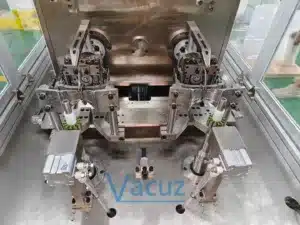
How to changeover and debugging a brushless motor stator winding machine? What maintenance measures are required? Vacuz has provided a simple explanation above, and we hope this information is helpful!
 English
  Spanish
  Portuguese
  Italian
  German
  French
  Russian
  Turkish
  Polish
  Ukrainian
  Japanese
  Korean
  Chinese (Taiwan)
  Chinese (China)