















In addition to common components like servo motor drives, wiring systems, and electrical systems, some small parts play a crucial role in fully automatic stator winding machines, such as the wire nozzles and tensioners. Therefore, their selection is very important. So, how do you choose wire nozzles and tensioners for a fully automatic stator winding machine? How do you ensure accurate winding? Vacuz will give you a brief introduction below!
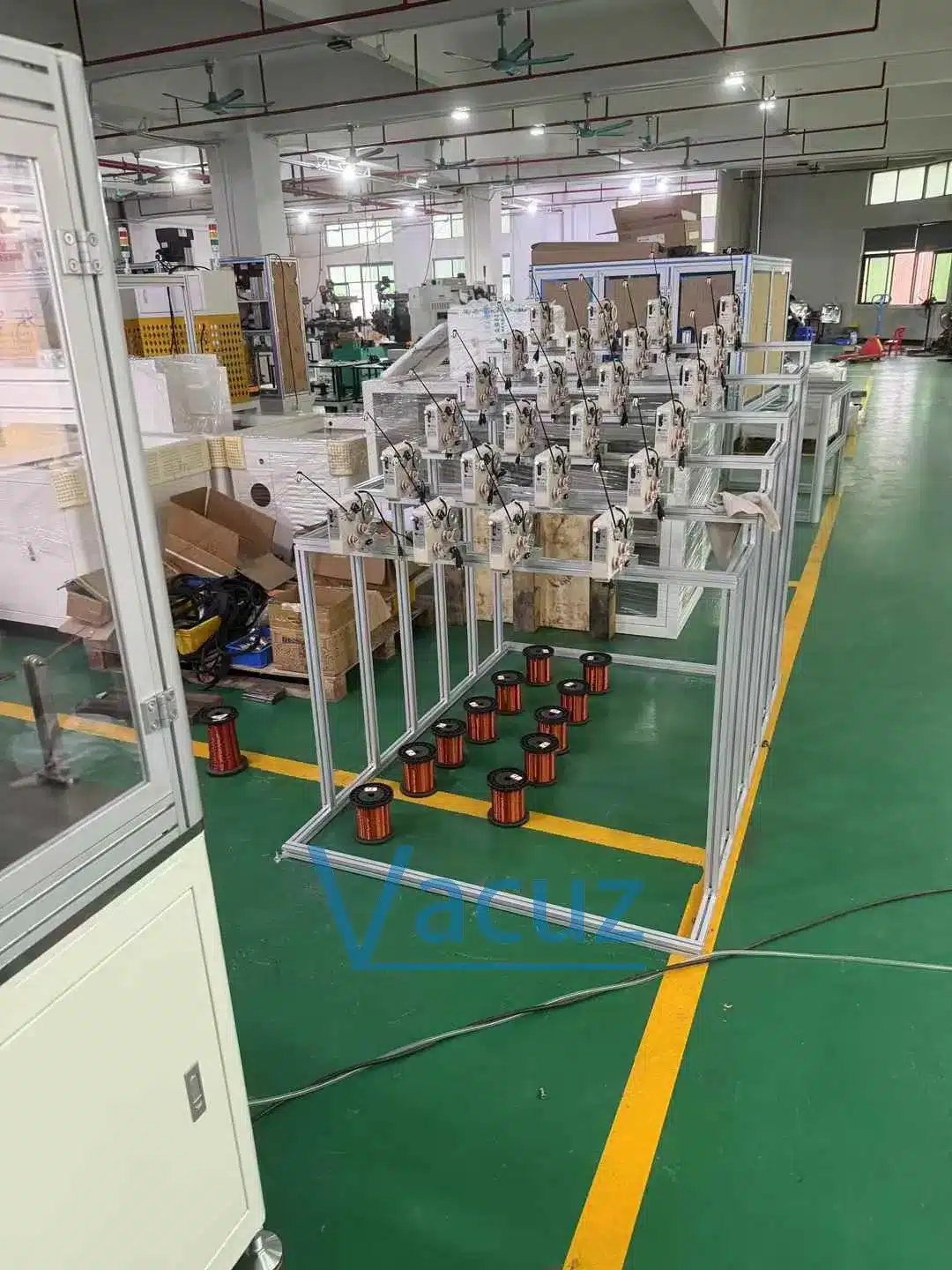
I. Wire Nozzle Selection Standards and Strategies
1. Materials and Wear Resistance
Core Requirements: The wire nozzle must possess high hardness and excellent wear resistance to withstand high-speed friction and continuous wire abrasion.
Recommended Materials: Prioritize hard materials such as tungsten carbide, ceramic-coated steel, or heat-treated carbon steel to avoid frequent replacements due to the use of ordinary steel.
Application Scenarios:
High-speed winding (e.g., brushless motor stators): Tungsten carbide or ruby wire nozzles to ensure wear resistance and low friction.
Fine wire winding (e.g., 0.05mm enameled wire): Wire nozzles with a mirror-finish surface treatment to prevent scratching the insulation layer.
1. Multi-wire winding: Select a high-precision wire nozzle with a bore tolerance of ±0.01mm to avoid inter-wire interference.
2. Size matching and structural optimization
Inner diameter design: The inner diameter of the wire nozzle should be 1.1-1.3 times the wire diameter to ensure tight winding and prevent wire jamming.
Lightweight design: Use lightweight materials such as titanium alloy to reduce inertia, improve dynamic response speed, and reduce high-speed vibration.
Customization capability: Supports processing based on drawings, adapting to non-standard stator slot direction, outer diameter, and other parameters.
3. Surface treatment and compatibility
Mirror grinding: The roughness of the inner hole and key parts must reach Ra≤0.1, and Ra≤0.025 at curved areas to prevent damage to the enameled wire.
Compatibility verification: Select the wire nozzle shape according to stator parameters (such as slot size and winding density) to ensure matching with the winding machine model.
II. Tensioner Selection Standards and Strategies
1. Control Accuracy and Stability
Closed-loop Control: Magnetic powder tensioners or servo tensioners are preferred due to their fast response speed, high control accuracy, and tension fluctuation range ≤ ±0.5N.
Dynamic Adjustment: Supports real-time monitoring of tension changes and automatic compensation to prevent wire breakage or coil loosening.
Application Scenarios:
Fine Wire Winding: Reduces tension to prevent breakage (e.g., 0.5-5N for copper wire, 0.3-3N for aluminum wire).
High-Speed Winding: Selects a high-torque tensioner to ensure stable tension.
2. Range and Fine-tuning Capability
Range Coverage: Selects the tensioner range based on wire diameter and winding speed to ensure support for tension requirements.
Fine-tuning Accuracy: Features high-resolution adjustment (e.g., 0.1N steps) to adapt to diverse winding needs.
Intelligent Functions: Supports data recording and remote monitoring for easy process analysis and fault tracing.
3. Sensors and Feedback System
Tension Sensor: Provides real-time feedback of tension values to the control system; automatically stops and alarms in case of abnormalities. Vibration Suppression: Through a closed-loop servo system and algorithm, the jitter amplitude during high-speed winding is controlled within ±0.01mm.
III. Measures to Ensure Winding Accuracy
1. Equipment Hardware Optimization
Core Component Precision: Ensure the machining accuracy of guide rails, lead screws, spindles, etc., reaches ±0.05mm, and conduct regular inspections and maintenance.
High-Rigidity Dies: Dies are made of high-strength alloy steel to prevent deformation during winding.
Shock Reduction and Noise Reduction: Vibration damping pads are installed at the bottom of the equipment to reduce the impact of vibration on accuracy.
2. Process Parameter Settings
Winding Speed Matching: Adjust the speed according to the wire diameter (e.g., reduce the speed to 500-800 r/min for thin wire, and up to 1200 r/min for thick wire).
Wire Laying Spacing Control: Forced laying must ensure that the preset distance (usually the wire diameter) is stepped for each turn, with an error ≤±0.01mm.
Dynamic Tension Adjustment: Optimize the tension curve in real time through a PID algorithm to prevent wire breakage or loosening.
3. Environmental and Operational Management
Temperature and Humidity Control: Maintain workshop temperature at 20±2℃ and relative humidity ≤65% to prevent electronic component failure or electrostatic discharge.
Standardized Operation: Develop detailed SOPs, including changeover, debugging, and maintenance procedures, to ensure operational consistency.
Regular Calibration: Use tools such as laser rangefinders and tension gauges to detect wear on the wire nozzles and the accuracy of the tensioner, replacing aging components promptly.
4. Intelligent Monitoring and Data Analysis
Vision Inspection System: Scans the winding surface in real time, automatically correcting defects such as missing wires and overlaps.
Data Recording and Analysis: Records winding parameters, fault codes, and other data, using big data to optimize processes and improve production efficiency.
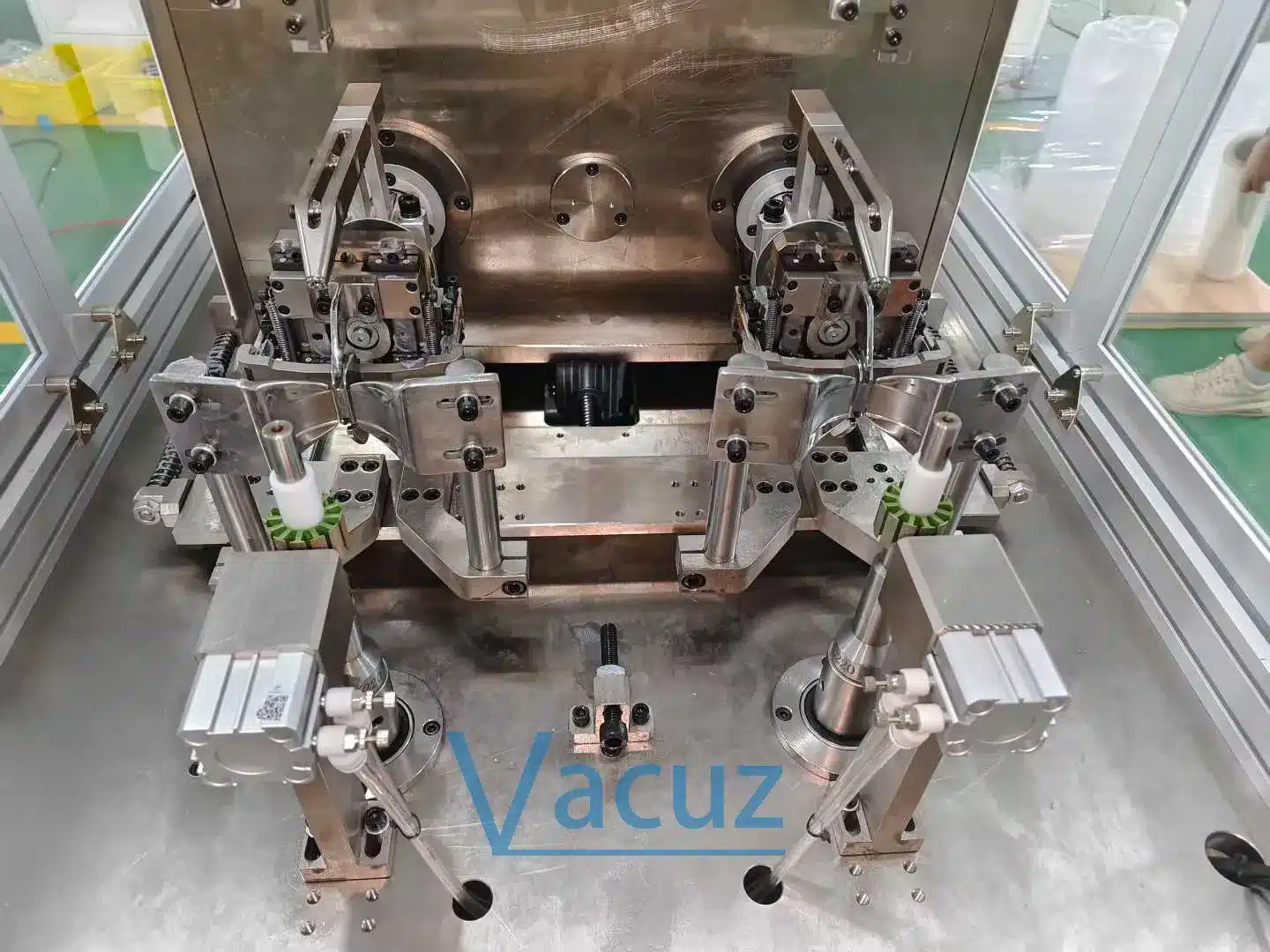
How to select wire nozzles and tensioners for a fully automatic stator winding machine? How to ensure accurate winding? Vacuz has provided a simple explanation above; we hope this information is helpful!
 English
  Spanish
  Portuguese
  Italian
  German
  French
  Russian
  Turkish
  Polish
  Ukrainian
  Japanese
  Korean
  Chinese (Taiwan)
  Chinese (China)