















For mass production of drone motors, both stator and rotor assembly require automated equipment. So, how should a production line for 3115 drone motor assembly be designed? How are the rotor and stator assembled? Below, Vacuz will give you a brief introduction!

I. Core Principles of Production Line Design
1. Modular Layout
Independent workstations are divided according to assembly processes (such as stator winding, rotor magnet insertion, assembly and pressing, inspection, etc.). Workpiece flow is achieved through conveyor belts or robotic arms, reducing manual handling. For example, Vacuz’s 3115 drone motor production line uses an integrated workstation for “glue application → magnet insertion → back cover pressing,” allowing a single machine to complete multiple processes, shortening the cycle time by 30%.
2. Automated Integration
Stator Winding: A dual-station pin-type winding machine is used, supporting wire diameters of 0.08-1.3mm, winding speed ≥2000RPM, and wire alignment accuracy ±0.05mm, adaptable to 3115 stator slot types (such as a 12-slot fractional structure).
Rotor Assembly: A dual-disk automatic magnet insertion machine is used, inserting 8 magnets in two stages (16 magnets in total for V-type rotors). The magnet positioning accuracy is ±0.1mm, avoiding misalignment caused by manual magnet insertion.
Assembly and Pressing: An automatic stator-rotor assembly machine is used, with the pressing force controlled by a servo motor (recommended 500-1000N). The pressing speed is ≤2 seconds/piece, ensuring uniform air gap (target value 0.3±0.05mm).
3. Flexible Design
Supports rapid model changeover. Different stator models (e.g., stack thickness 20-30mm, outer diameter 50-70mm) can be adapted by adjusting fixtures and program parameters. For example, a quick-change mold interface is used, with mold changeover time ≤15 minutes.
4. Quality Traceability System
Each workstation is equipped with a barcode scanner, binding the workpiece QR code with production data (e.g., winding turns, pressing pressure, inspection results) to achieve full-process traceability.
II. Detailed Explanation of Rotor Assembly Process
Taking the V-type rotor of the 3115 UAV motor as an example:
1. Magnet Guide Frame Installation
Automatic feeding via vibratory feeder transports the magnet guide frame to the assembly station, where a robotic arm grasps and positions it onto the rotor core.
2. Glue Dispensing Process
A high-precision dispensing valve is used, with glue flow controlled within ±0.01ml, ensuring glue dispensing uniformity ≥95% and preventing magnet detachment. The glue curing time must match the production line cycle (e.g., 30 seconds).
3. Automatic Magnet Insertion
Dual-disk design: Two disks are magnetized in two stages, eight disks each time, with alternating magnet polarities (N-S-N-S).
Visual Positioning: An industrial camera detects magnet angle deviation (allowable error ±0.5°), automatically rejecting defective products.
Pressure Monitoring: The magnet insertion pressure is fed back to the PLC in real time; exceeding the limit (e.g., >50N) triggers an alarm and shutdown.
4. Rear Cover Pressing
A servo press is used, with pressing depth controlled at ±0.02mm to ensure the coaxiality of the rear cover and rotor core is ≤0.05mm.
III. Stator Assembly Process Details
1. Winding Process
Tension Control: Tension is dynamically adjusted according to wire diameter (e.g., 0.8N for 0.2mm wire, 1.5N for 0.5mm wire) to prevent wire breakage or loosening.
Wire Layout Optimization: An “S”-shaped winding path is adopted, with wire spacing uniformity of ±0.03mm, reducing the risk of inter-turn short circuits.
Turn Count Detection: The number of turns is monitored in real time using a Hall sensor; automatic shutdown occurs if the error >1%.
2. Insulation Treatment
After winding, the wire is impregnated with insulating varnish (e.g., polyesterimide varnish), dried at 120±5℃ for 60 minutes, achieving insulation class F (155℃).
3. Stator Core Assembly
The windings are pressed into the core using a hydraulic press, with pressure controlled at 2000±100N to ensure tight winding.
IV. Stator and Rotor Assembly Process
1. Air Gap Control
During assembly, the air gap is monitored in real time using a laser rangefinder, and the rotor position is dynamically adjusted to ensure air gap uniformity of ±0.05mm.
2. Bearing Press-fitting
The bearings are pressed using a servo press, with pressure controlled at 1000±50N and a pressing speed ≤5mm/s to avoid bearing damage.
3. Dynamic Balance Correction
After assembly, dynamic balance testing is performed. The imbalance is ≤0.5g·cm, and adjustment is made by removing weights or using counterweights.
V. Production Efficiency and Cost Optimization
Cycle Time Matching: The cycle time of a single production line is ≤15 seconds/unit (including rotor, stator, and assembly), with a daily production capacity ≥2000 units.
Yield Improvement: Automated inspection increases the yield from 85% to 98%, reducing rework costs. Space utilization: A vertical layout (e.g., stacking winding machines and assembly machines) saves 30% of floor space.
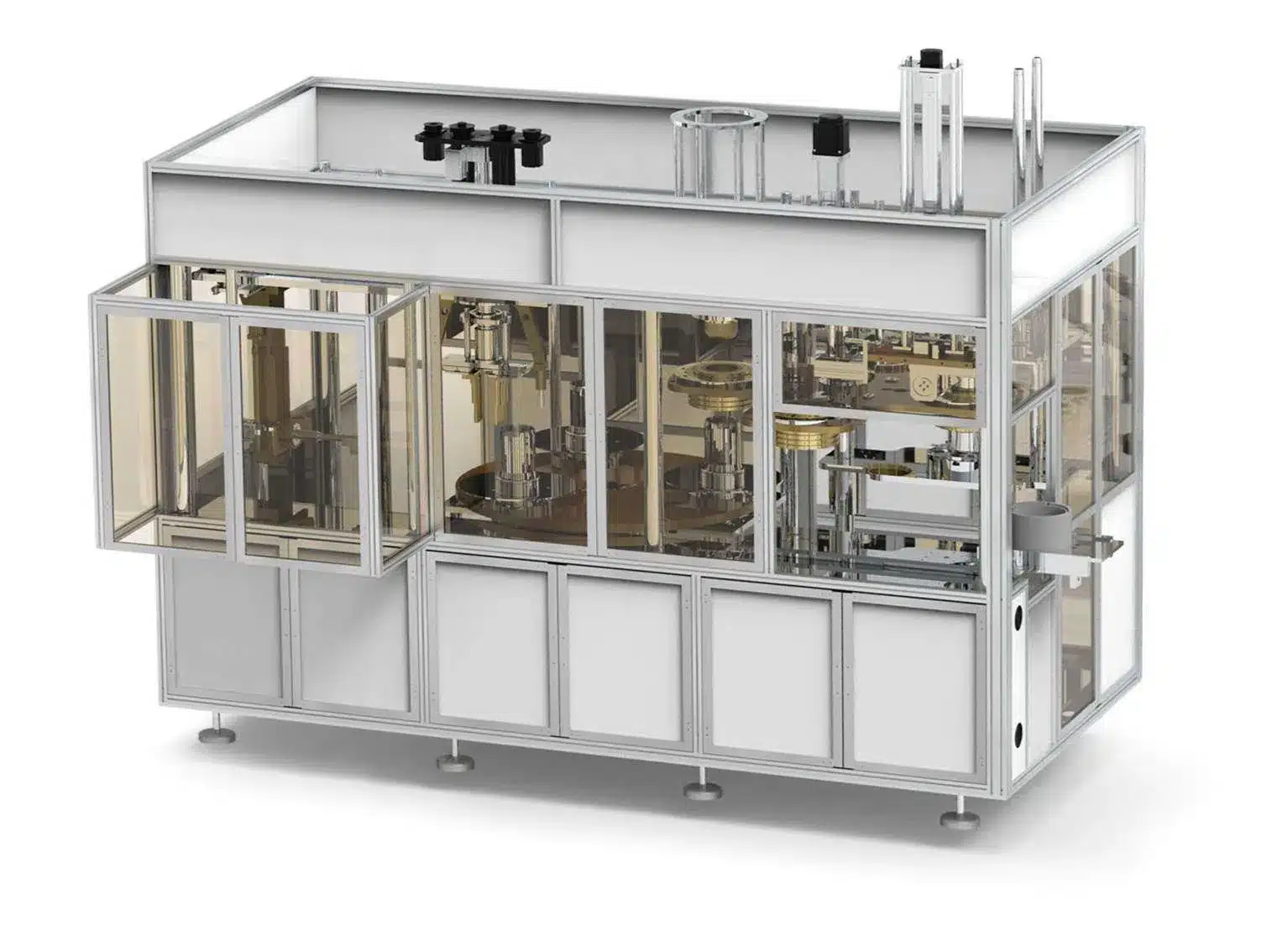
How to design a 3115 UAV motor assembly line? How are the rotor and stator assembled? Vacuz has provided a simple explanation above; we hope this information is helpful!
 English
  Spanish
  Portuguese
  Italian
  German
  French
  Russian
  Turkish
  Polish
  Ukrainian
  Japanese
  Korean
  Chinese (Taiwan)
  Chinese (China)