















Automatic brushless motor winding machines can use multiple stator models, but this requires meeting various conditions, including equipment parameters, mold design, and process control. Only by fully understanding these requirements and considerations can the winding process be ensured to proceed normally. So, how can an automatic brushless motor winding machine be compatible with multiple stator models? What issues should be considered? Below, Vacuz will provide a brief introduction!

I. Equipment Parameter Compatibility
1. Stack Thickness Range
If the stator stack thickness difference is small (e.g., ≤5mm), it can be achieved by adding shims or adjusting the mold height. If the difference exceeds the equipment’s allowable range (e.g., >10mm), the mold needs to be replaced or the equipment parameters adjusted.
Example: Model aircraft motor stators (1103/1105/1108 series) have small stack thickness differences and can share molds; however, power tool stators have large stack thickness differences and require custom molds.
2. Outer Diameter and Inner Diameter Matching
The equipment must support the upper limit dimensions of the stator’s outer and inner diameters. If these limits are exceeded, the tooling needs to be changed or the fixture adjusted.
Data: General-purpose winding machines typically support stators with outer diameters of 50-200mm and inner diameters of 20-100mm.
3. Wire Diameter Compatibility
The equipment needs to be equipped with an adjustable tension system to accommodate enameled wires of different diameters (e.g., 0.08-1.3mm). For thicker wires (e.g., >1.0mm), the winding speed should be reduced (recommended ≤300RPM) to avoid wire damage.
Case Study: A car water pump motor stator (1.2mm wire diameter) requires a non-standard customized model; ordinary equipment is prone to wire breakage.
II. Mold Design and Replacement
1. Standardized Mold Interface
Using a quick-change system (e.g., pneumatic clamping, locating pin alignment) reduces mold change time to within 10 minutes, improving equipment utilization.
Optimization Solution: Modular mold design, adapting to different stators by replacing local components (e.g., slot guide blocks).
2. Adjustable Mold Structure
Fine-tuning of mold dimensions can be achieved through screw adjustment or shim stacking, reducing mold costs. Example: The same mold can accommodate stators with a thickness difference of ±3mm by adding or removing shims.
3. Multi-station layout
Four-station or six-station models can process different stator models simultaneously, reducing downtime.
Efficiency comparison: Six-station models are 500% more efficient than single-station models, suitable for multi-variety, small-batch production.
III. Key Points of Process Control
1. Dynamic tension adjustment
Equipped with a servo tension controller, the tension is automatically adjusted according to wire diameter and material (error ≤ ±5%). For thicker wires, the tension should be reduced (e.g., 0.8N/mm²), and for thinner wires, the tension should be increased (e.g., 1.5N/mm²) to prevent loosening.
Risk: Tension fluctuations >10% can lead to wire breakage or short circuits between turns.
2. Optimized wire winding mechanism
Using laser calibration or a vision positioning system, the wire winding spacing is ensured to be uniform (error ≤ ±0.05mm). When multiple wires are wound in parallel, the slot distance needs to be increased (20%-30% more than for a single wire). Case Study: The slot width of a power tool stator (4 wires wound in parallel) needs to be increased from 2.5mm to 3.0mm.
3. Adaptive Winding Algorithm
The winding path is dynamically adjusted according to the stator slot shape to avoid wire damage. For example, V-shaped slots require an “S”-shaped winding path, while rectangular slots use a straight winding path.
Result: The adaptive algorithm reduces the wire damage rate from 5% to 0.2%.
IV. Operation and Maintenance Specifications
1. Programmable Parameter Management
Pre-stored winding programs (such as number of turns, speed, tension) for different stator models can be recalled with a single touch on the touchscreen.
Data: Programmable operation reduces debugging time from 30 minutes to 5 minutes.
2. Real-time Monitoring and Feedback
Integrated sensors monitor parameters such as winding tension, number of turns, and wire alignment. Automatic shutdown and alarm are triggered in case of abnormalities.
Case Study: When tension exceeds the limit (>2.0N/mm²), the equipment stops within 0.5 seconds and prompts for adjustment.
3. Regular Maintenance and Calibration
Clean the guide rollers and tension sensors weekly; lubricate the lead screw and guide rails monthly; calibrate the laser positioning system quarterly.
Impact: Improper maintenance can lead to decreased equipment accuracy (e.g., increased wire routing error to ±0.2mm).
V. Special Scenario Solutions
1. Cross-Series Adaptation
Within the equipment’s permissible range, similar products (e.g., external/internal winding) can share the same equipment, but multiple sets of molds need to be customized.
Limitations: External winding equipment has lower efficiency (approximately 60%), and internal winding equipment is not suitable for externally wound stators.
2. Non-Standard Customization Services
For stator parameters exceeding the range (e.g., outer diameter > 300mm, wire diameter > 2.0mm), non-standard equipment customization is available, including reinforced frames and high-power servo motors.
Cost: Non-standard equipment is 30%-50% more expensive than standard models.
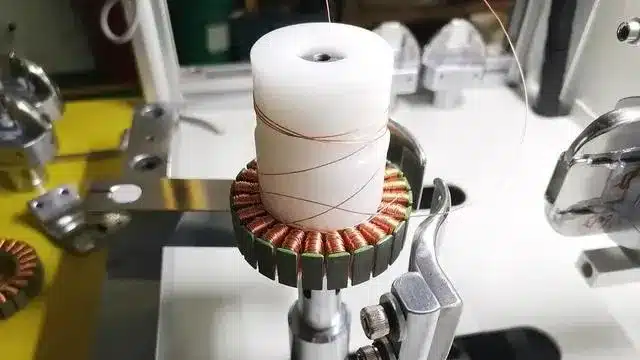
Can a fully automatic brushless motor winding machine be used with multiple stator models? What issues should be considered? The above provides a simple explanation of Vacuz, and we hope this information will be helpful!
 English
  Spanish
  Portuguese
  Italian
  German
  French
  Russian
  Turkish
  Polish
  Ukrainian
  Japanese
  Korean
  Chinese (Taiwan)
  Chinese (China)