















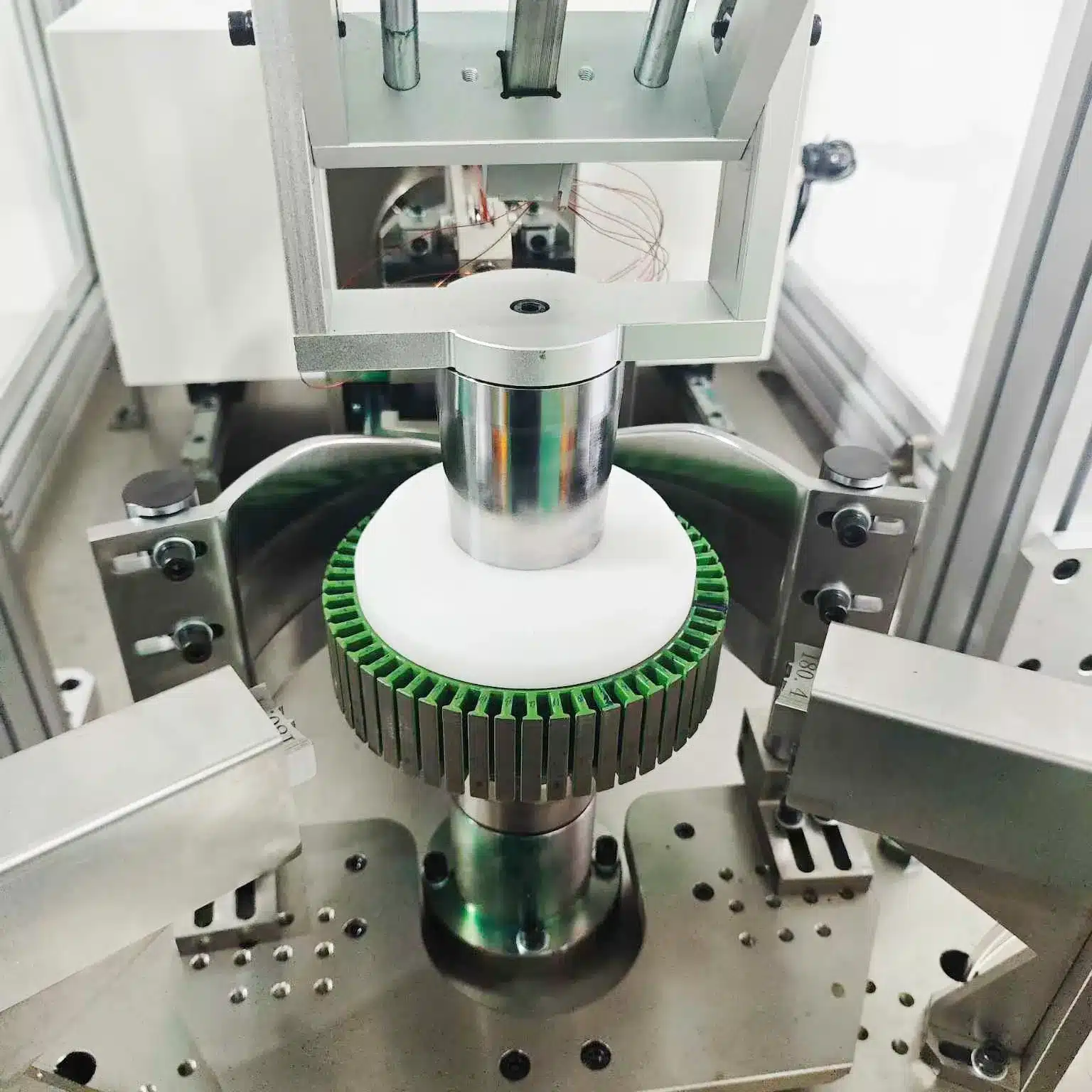
Flying fork winding machines and pin-type internal winding machines are two common types of stator winding equipment, differing significantly in structure, winding method, and applicable scenarios. Below is a comparison of their matching principles and differences. Vacuz will provide a brief introduction to help you understand them!

I. Matching Principles of Flying Fork Winding Machines and Pin-Type Internal Winding Machines
1. Matching Principles of Flying Fork Winding Machines
Applicable Stator Types:
Externally wound stators: Such as brushless DC motors, stepper motors, fan motors, etc., where the coils are wound outside the stator slots.
Small-sized stators: Outer diameter typically less than 150mm, stack thickness (height) less than 50mm, suitable for high-speed winding.
Simple slot type: Such as open or semi-open slots, facilitating wire entry into the slot when the flying fork rotates.
Key Matching Points:
Flying fork diameter: Must match the stator slot diameter to avoid wire scratching or loose winding.
Rotation speed: Adjusted according to wire diameter and number of turns; high speed for thin wires, low speed for thick wires.
Wire arrangement method: Uses a rotating fork + lateral movement of the wire arranger, suitable for multi-layer winding or dense winding.
2. Matching principles for needle-type internal winding machines
Applicable stator types:
Internal winding stators: Such as air conditioner compressor motors, industrial servo motors, etc., where the coil is wound inside the stator slots.
Large-size stators: Outer diameter is usually greater than 150mm, stack thickness (height) exceeds 50mm, requiring high-precision winding.
Complex slot types: Such as slanted slots, closed slots, or deep slots, requiring accurate insertion of the needle bar into the slot for winding.
Matching points:
Needle bar diameter: Must be smaller than the width of the stator slot opening to ensure smooth insertion into the slot.
Up-and-down movement speed: Adjusted according to wire diameter and number of turns; thin wires can move up and down quickly, thick wires require slow movement to avoid breakage.
Wire routing accuracy: Requires a high-precision wire routing device to ensure inter-turn insulation and neat wire routing.
II. Core Differences Between Flying Fork Winding Machines and Pin-Type Internal Winding Machines
1. Flying Fork Winding Machine
The flying fork rotates during winding, with the wire entering the slot from the outside of the stator. Suitable for open and semi-open slots, and small stator sizes (outer diameter <150mm, stack thickness <50mm). High winding speed (≥3000 rpm). Wire routing accuracy depends on the rotation of the flying fork and the lateral movement of the wire routing device. Ordinary machines have a simple structure and low maintenance costs. However, high-end machines, equipped with professional servo motor drives, achieve precise and accurate winding.
2. Pin-type Internal Winding Machine
The pin bar moves up and down to wind the wire, which enters the slot from the inside of the stator. Suitable for closed slots, slanted slots, and deep slots, and large sizes (outer diameter > 150mm, stack thickness > 50mm). Medium to low speed (500-2000 rpm). Wire arrangement relies on the up-and-down movement of the pin bar and a high-precision wire arranger. The equipment is relatively complex and requires a professional servo motor drive.
III. Selection Recommendations for Practical Applications
1. Selection Based on Stator Type:
If the stator is externally wound and the slot shape is simple, a fly-fork winding machine is preferred due to its high efficiency and low cost.
If the stator is internally wound or has a complex slot shape (such as closed slots or slanted slots), a pin-type internal winding machine is necessary to ensure winding accuracy and inter-turn insulation.
2. Selection Based on Production Scale:
For mass production (e.g., annual output > 1 million units): a fly-fork winding machine can significantly reduce costs.
For small-batch, multi-variety production (such as customized motors): Pin-type internal winding machines offer greater flexibility and adaptability to different stator sizes.
3. Selection based on precision requirements:
For high requirements on coil turn insulation and wire alignment: Choose a pin-type internal winding machine.
For general precision requirements (such as fan motors): A fly-fork winding machine is sufficient.
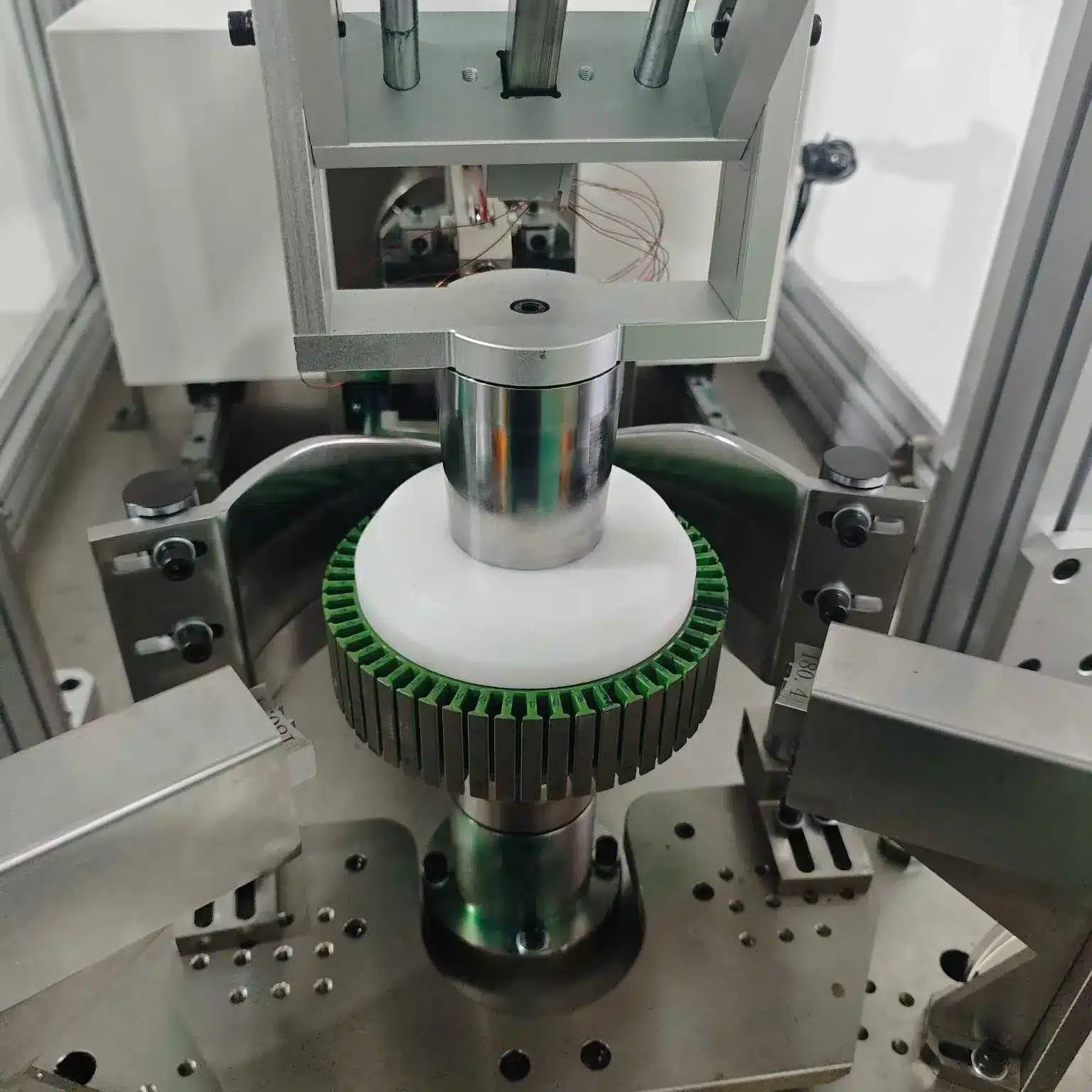
How to match fly-fork winding machines and pin-type internal winding machines with appropriate stators? How to distinguish between the two? Vacuz has provided a simple explanation above; hopefully, this information will be helpful!
 English
  Spanish
  Portuguese
  Italian
  German
  French
  Russian
  Turkish
  Polish
  Ukrainian
  Japanese
  Korean
  Chinese (Taiwan)
  Chinese (China)