














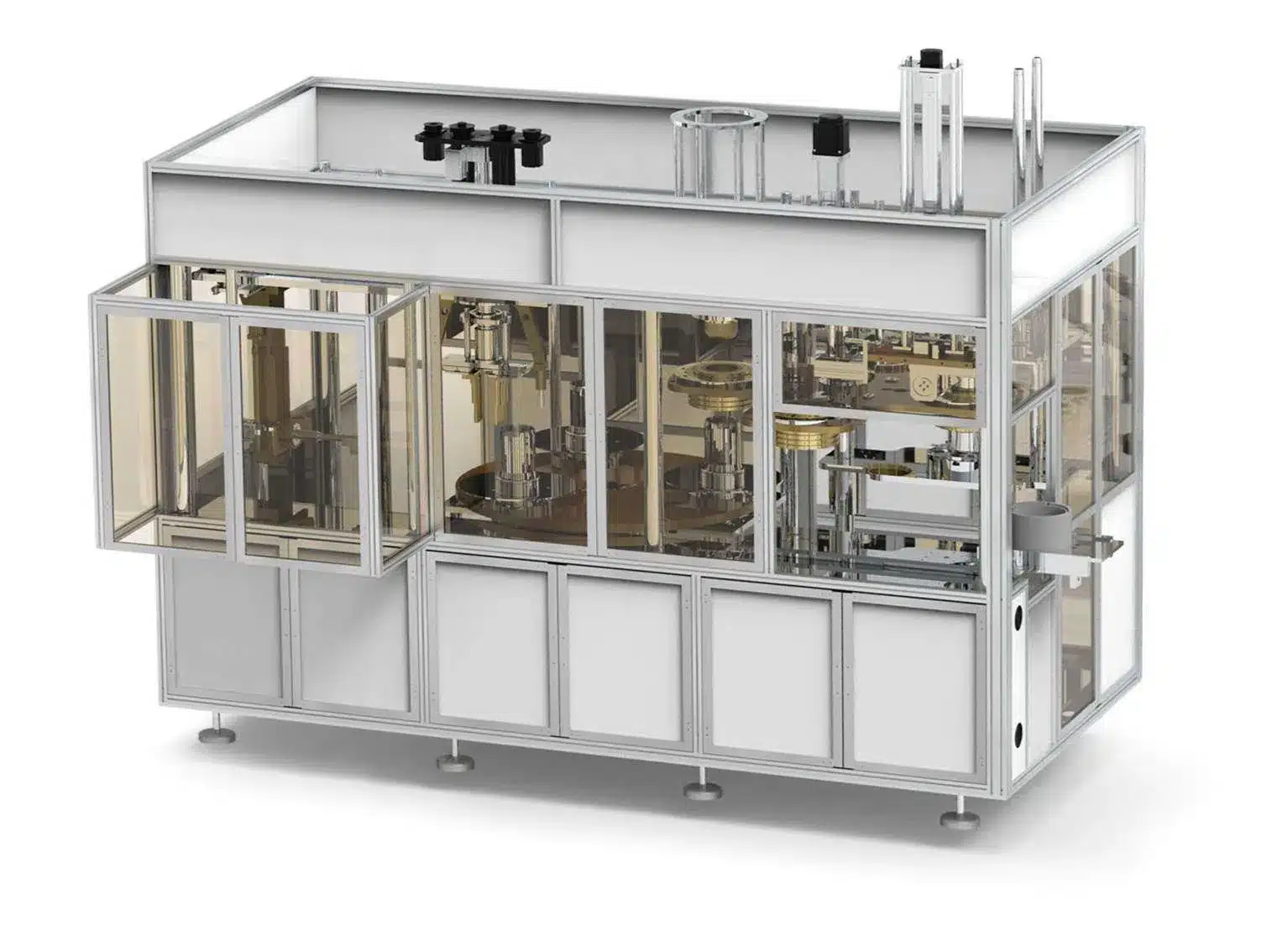
The production of brushless motor rotors is gradually becoming intelligent, and many factories have adopted specialized production line equipment. This not only improves the efficiency of motor manufacturing but also enhances motor quality and the overall image of the factory. So, what factors affect the precision of an automated motor rotor production line? How can rotor assembly precision be improved? Below, Vacuz will give you a brief introduction!

I. Core Factors Affecting Rotor Assembly Precision
1. Equipment Hardware Precision
Core Components: The precision of moving parts such as servo motors, ball screws, guide rails, and cylinders directly affects positioning and repeatability.
Specialized Equipment: Press-fitting equipment, automatic winding machines, laser welding machines, etc., must meet the assembly requirements of rotor cores, magnets, shafts, and other components.
Molds and Tooling: Mold precision must be controlled within tolerance range and must be wear-resistant and deformation-resistant. Mold deviations will directly lead to winding misalignment or magnet assembly tilting.
2. Electrical and Control Systems
Servo Control Algorithm: S-shaped acceleration and deceleration control can reduce the impact of sudden speed changes on wire laying. Closed-loop tension control keeps tension fluctuations within ±3%, avoiding coil deformation or breakage. 3. Sensors and Feedback: High-precision sensors (such as laser rangefinders and force sensors) monitor parameters such as air gap and pressing force in real time, and adjust actions through closed-loop feedback.
4. Material and Process Compatibility:
Enameled Wire: Wire diameter uniformity affects wire density; insulation toughness must withstand tension without cracking.
Magnets and Cores: The accuracy of magnet positioning grooves and the control of adhesive layer thickness affect magnet assembly strength; core stacking flatness must be ensured by high-precision stamping dies.
Bearings and Shafts: Bearing clearance accuracy and shaft journal surface roughness must meet assembly requirements; otherwise, pressing jamming or insufficient preload may occur.
5. Environment and Operation Management:
Vibration and Temperature/Humidity: Ground vibration should be ≤0.5mm/s; workshop temperature differences exceeding 5℃ may cause mechanical deformation; humidity exceeding 60%RH may cause static electricity or wire moisture absorption.
Personnel Skills: Operators must undergo specialized training (such as tension adjustment and die replacement); key positions require certification to reduce human error. Maintenance and Calibration: Regularly check the lead screw accuracy and calibrate sensors (e.g., quarterly), establish equipment maintenance records, and ensure long-term stability.
II. Key Measures to Improve Rotor Assembly Accuracy
1. Equipment Upgrade and Configuration Optimization
High-Precision Hardware: Use imported servo motors, precision ball screws, and guide rails, paired with tungsten carbide or ceramic-coated wire nozzles to reduce wire scratches.
Closed-Loop Control System: Employ force-displacement closed-loop control of the pressing process, combined with machine vision detection of magnet polarity (error rate reduced to below 0.1%), and adjust parameters in real time.
Modular Design: Support rapid switching between multiple rotor models (changeover time ≤ 15 minutes) through quick mold changes and flexible fixtures, improving production line flexibility.
2. Refined Control of Process Parameters
Tension Management: Preset tension based on wire diameter and establish a speed-tension mapping model.
Pressure Pressing Process: Optimize pressing speed and holding time through pressure-displacement curve analysis to avoid bearing deformation or journal damage.
Dynamic Balancing Correction: Laser or milling weight removal is used to control residual imbalance to within 0.2 g·mm/kg, reducing operating noise and vibration.
3. Environmental Control and Material Management
Constant Temperature and Humidity Workshop: Temperature is controlled at 25±2℃, and humidity at 50±5%RH, reducing mechanical deformation and static electricity effects.
100% Material Inspection: 100% visual inspection and SPC trend analysis are performed on incoming materials (such as magnets and bearings) to prevent defective products from entering the assembly process.
Intelligent Logistics: Automated workpiece flow is achieved through AGVs or pallet chains, reducing positioning deviations caused by manual handling.
4. Intelligent Detection and Data-Driven Operation
Online Detection: Integrates multiple sensors such as pressure, displacement, and temperature to monitor key parameters (such as pressing force and air gap) in real time. Automatic shutdown and alarm are triggered in case of abnormalities.
Quality Traceability: A unique identification code is used to record assembly parameters and inspection data to the MES system, enabling full lifecycle traceability.
Data Analysis: AI algorithms are used to analyze defective data, optimize process parameters, and continuously improve yield. 5. Personnel Training and Standardized Operations
Phase-based Training: Operators receive specialized training in equipment operation, daily inspections, and troubleshooting. They are only allowed to work after passing an assessment.
Standardized Processes: Standard Operating Procedures (SOPs) are developed (e.g., mold changeover procedures, parameter adjustment specifications), clearly defining the operational steps and quality standards for each process to reduce human error.
Incentive Mechanism: Quality improvement rewards are established to encourage employees to provide optimization suggestions (e.g., mold improvement, tooling simplification), promoting continuous improvement.

What factors affect the precision of an automated motor rotor production line? How to improve rotor assembly precision? Vacuz has provided a simple explanation above; we hope this information is helpful!
 English
  Spanish
  Portuguese
  Italian
  German
  French
  Russian
  Turkish
  Polish
  Ukrainian
  Japanese
  Korean
  Chinese (Taiwan)
  Chinese (China)