















Rotors have many components, including various large and small parts. Assembling these parts manually is time-consuming and labor-intensive, unsuitable for modern factory production. So, what are the standards and requirements for automated rotor assembly lines? How should assembly equipment be configured rationally? Vacuz will give you a brief introduction below!
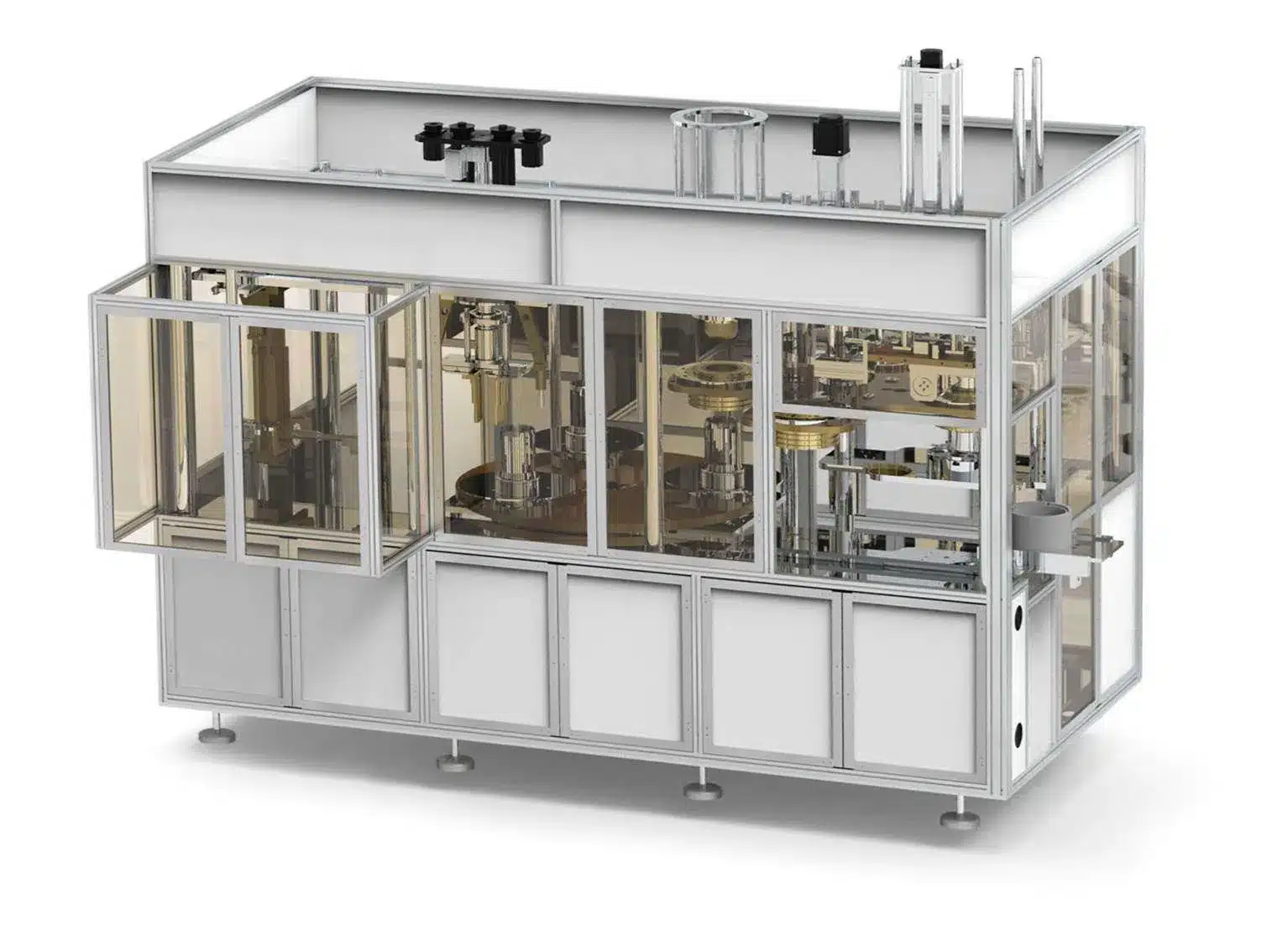
I. Core Standards and Requirements for Automated Rotor Assembly Lines
1. Precision and Stability Standards
Mechanical Precision: Key components (such as servo motors, ball screws, and linear guides) must meet a positioning accuracy of ±0.01mm to ensure the repeatability of winding, pressing, and other processes.
Pressure Control: Pressure fluctuations in the pressing equipment must be ≤±0.1N to prevent poor magnet adhesion or core deformation.
Dynamic Balance Precision: Dynamic balance testing must reach G1 level, with vibration values ≤1.5mm/s to prevent imbalance during high-speed operation.
Environmental Adaptability: The production line must operate stably in an environment with a temperature of 20-25℃ and humidity of 40-60%RH, equipped with a constant temperature and humidity system and an electrostatic elimination device.
2. Equipment Performance Requirements
Automation Level: Full-process automation including loading/unloading, gluing, magnet insertion, pressing, and testing, minimizing manual intervention.
Flexible Production: Supports rapid changeover for multiple product types, achieving changeover within 30 minutes through parametric programming and modular fixtures.
Real-time Monitoring: Equipped with inductance testers, insulation resistance testers, etc., achieving 100% process monitoring, with data uploaded to the MES system in real time.
Safety Protection: Complies with IEC 60204-1 standards, equipped with leakage protection, light curtains, safety doors, and millimeter-wave radar to detect personnel intrusion.
3. Process Flow Specifications
Standard Procedure: Core loading → Positioning → Gluing → Magnet insertion → Magnetic flux testing → Shaft pressing → Balance block pressing → Dynamic balancing test → Bearing installation → Laser marking → Unloading.
Error Prevention Mechanism: Automatic shutdown upon detection of incorrect magnet polarity by sensors, mechanical limits to prevent incorrect assembly, and AI vision recognition for defects as small as 0.1mm.
Quality Traceability: A unique code is generated for each rotor, recording production batches, process parameters, and test results, supporting full lifecycle traceability.
II. Rational Configuration Scheme for Assembly Equipment
1. Core Equipment Selection
Winding Machine: A high-speed winding machine with a speed ≥5000rpm is selected, equipped with torque control technology to ensure winding tension fluctuation ≤±0.2N.
Pressure Pressing Equipment: A high-precision servo pressure pressing machine is adopted, with pressure control accuracy ±0.1N, supporting real-time analysis of pressure-displacement curves and automatic identification of micro-cracks.
Dynamic Balancing Tester: Equipped with a laser velocimetry system and a de-weighting drilling device, supporting G1-level accuracy and automatically correcting imbalance.
Welding Equipment: Laser welding is promoted to replace spot welding, reducing the heat-affected zone and increasing the weld qualification rate to 99.9%.
2. Auxiliary Equipment Configuration
Loading and Unloading System: Integrating a vibratory feeder, conveyor belt, and robotic arm, it realizes automatic feeding and sorting of parts, equipped with a 3D vision camera with positioning accuracy ±0.02mm.
Inspection Equipment: AI vision inspection system (resolution ≥ 2 million pixels) identifies defects in processes such as magnet pasting and winding, with a recognition rate ≥ 99.5%.
Material Management: Utilizes an automated material storage system and AGV carts, supporting 8-hour uninterrupted production. A WMS system prevents material mixing.
Environmental Control: ISO Class 7 cleanroom with an air filtration system to prevent contamination. Temperature and humidity monitoring ensures production stability.
3. Layout Optimization Strategy
U-shaped Production Line Layout: Shortens material handling distances, reduces operator movement, and improves production line efficiency.
Parallel Design: Breaks down sequential processes (such as winding, dipping, and welding) into parallel workstations, seamlessly connected by AGVs or high-speed conveyors, shortening the production cycle.
Modular Structure: Independent functional modules (loading, positioning, assembly, and inspection) support rapid changeover, reducing downtime by more than 50%.
Virtual Debugging: Builds a digital model of the production line in the MES system, verifying process parameters in advance and reducing trial-and-error costs in actual production.
4. Intelligent Upgrade Directions
Predictive Maintenance: Using vibration sensors and AI algorithms, provide early warnings of guide rail wear or servo motor bearing failure 3-7 days in advance, reducing unplanned downtime.
AR-Assisted Learning: Utilize head-mounted displays to overlay virtual operation guidance (such as visualization of pressing force), reducing new employee onboarding time by 50%.
Data-Driven Optimization: Employ SPC analysis to identify fluctuation trends in key process parameters, pinpoint variation points, and implement improvements, forming a PDCA closed loop.

What are the standards and requirements for rotor automated assembly lines? How should assembly equipment be configured rationally? Vacuz has provided a brief explanation above; we hope this information is helpful!
 English
  Spanish
  Portuguese
  Italian
  German
  French
  Russian
  Turkish
  Polish
  Ukrainian
  Japanese
  Korean
  Chinese (Taiwan)
  Chinese (China)