















For brushless motors, such as those used in small water pumps and high-speed air blowers, the internal winding of stators requires high production volumes. Ordinary small machines cannot meet the normal demand, necessitating a six-station machine. So, what are the functions and configurations of a six-station high-speed precision internal winding machine? How can winding efficiency be improved? Vacuz will give you a brief introduction below!
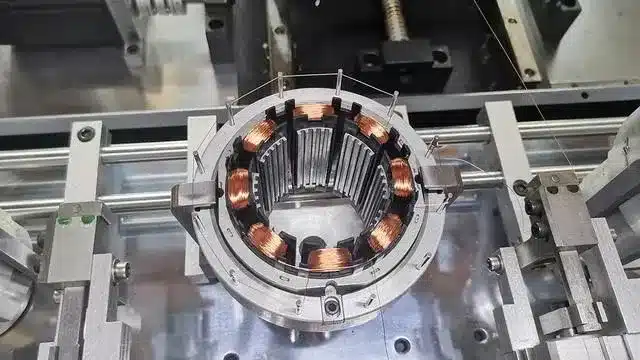
I. Core Function Analysis
1. Multi-station Synchronous Operation
The six-station design can wind six stators simultaneously, achieving winding speeds exceeding 1000 RPM. The no-load speed can reach 800-1000 RPM, and the speed with wire is approximately 700 RPM.
2. Precision Wire Laying Control
Electronic cam technology: The rotary axis, upper and lower axes are synchronously bound to the main spindle, ensuring rapid wire laying response and smooth curves during high-speed winding, avoiding wire crossing or damage.
Spiral interpolation winding: Three-axis linkage (X/Y/Z axes) achieves a spiral upward circular motion, quickly fixing the enameled wire and reducing manual intervention.
**Full Closed-Loop Pulse Positioning:** Position feedback is obtained via a motor encoder, and the PLC performs high-speed calculations to control servo full closed-loop positioning, achieving an accuracy of ±0.01mm, meeting high slot fill rate requirements.
3. **Automatic Operation Integration:**
Automatic loading and unloading: A robotic arm or dedicated clamp automatically picks up and clamps the stator core, with a changeover time of ≤5 minutes, supporting multi-model production.
Intelligent Fault Warning: Real-time monitoring of tension fluctuations, wire breakage, and other anomalies provides early warnings and shutdowns, reducing scrap rates.
Data Statistics and Analysis: Records production data (such as winding time and yield rate) to provide a basis for process optimization.
4. **Highly Adaptable Winding Process:**
Supports both standard and precision winding modes, with a turn count range of over 500 turns, adaptable to different stator parameters (e.g., outer diameter 20-30mm, wire diameter 0.1mm).
Programmable winding path control optimizes speed at corners, reduces wire bending stress, and avoids wire crossing.
** II. Key Configuration Requirements
1. Drive and Control System
Servo Motors: High-performance brands (e.g., Panasonic, Fuji, Delta) are selected, supporting high-speed response (≥1000 RPM) and low-vibration operation.
PLC Controller: A bus-type motion controller is used to achieve multi-axis synchronous control, with speed control accuracy ±2%.
Tension Control System: Closed-loop tension sensors monitor wire tension in real time, with fluctuation range ≤±5%, preventing wire breakage or slack.
2. Mechanical Transmission Components
Lead Screw and Guide Rails: Imported high-precision ball screws and linear guide rails, with high wear resistance and positioning error ≤±0.01mm.
Wire Nozzle and Tensioner: Precision-machined wire nozzles with a surface roughness ≤Ra0.8, combined with a high-accuracy tensioner, ensuring winding speed and quality.
Die and Fixtures: Dedicated die positioning accuracy ≤±0.02mm, quick-change structure supports multi-model production, changeover time ≤5 minutes.
3. Frame and Auxiliary Devices
Frame Material: Sheet metal base + stainless steel tabletop + aluminum alloy frame, ensuring stability and vibration resistance during high-speed operation.
Auxiliary Devices: Wool felt, wire guide rollers, guide pins, and other accessories need to be replaced regularly to prevent wear from affecting winding accuracy.
III. Strategies to Improve Winding Efficiency
1. Optimizing Winding Process Parameters
Segmented Speed Control: Reduce speed to 500-600 RPM in complex winding areas to ensure smooth wire transition; restore speed to 1000 RPM in straight areas to shorten overall winding time.
Dynamic Tension Compensation: Set differentiated tension according to wire diameter (e.g., copper wire, aluminum wire). Aluminum wire tension is 10%-20% lower than copper wire to prevent paint peeling; adjust tension in real time to counteract wire elastic deformation and ensure tight winding.
Wire Path Optimization: Use a special algorithm to generate a smooth path, reducing wire bending stress, avoiding wire crossing, and increasing slot fill factor to over 95%.
2. Hardware Upgrade
Servo Motor Upgrade: Utilizing a higher torque servo motor, supporting three-axis linkage interpolation, enabling spiral-up winding and reducing winding time by 30%.
Tension System Upgrade: Employing a closed-loop tension controller with a high-accuracy sensor, tension fluctuation range is reduced to ±3%, and wire breakage rate is lowered to below 0.5%.
Customized Molds and Fixtures: Optimizing the wire harness arrangement sequence for multi-wire winding processes to avoid inter-wire interference; mold positioning accuracy is improved to ±0.01mm, reducing debugging time.
3. Introduction of Intelligent Technology
Machine Vision Inspection: Integrating a high-speed camera to capture the moment the wire enters the slot in real time, dynamically correcting the fly fork angle (±2°) to ensure neat wire arrangement.
AI Algorithm Optimization: Analyzing historical production data through machine learning to automatically adjust winding parameters (such as speed and tension) for optimal efficiency.
IoT Integration: Supporting remote parameter adjustment and fault diagnosis, reducing downtime and improving overall equipment efficiency (OEE) to over 85%.
4. Maintenance and Operation Procedures
Regular Maintenance: Clean the equipment daily, lubricate the lead screw and guide rails weekly, and replace worn parts (such as wire nozzles and tensioners) monthly to ensure long-term stable operation.
Operator Training: Train operators to be familiar with equipment functions (such as process pause and reset commands), strictly adhere to operating procedures, and avoid efficiency losses due to human error.
Environmental Control: Maintain a stable installation site, keep the temperature between 20-25℃, humidity ≤60%, and keep away from vibration and pollution sources to ensure equipment accuracy.

What are the functions and configurations of the six-station high-speed precision internal winding machine? How to improve winding efficiency? Vacuz has provided a simple explanation above; we hope this information is helpful!
 English
  Spanish
  Portuguese
  Italian
  German
  French
  Russian
  Turkish
  Polish
  Ukrainian
  Japanese
  Korean
  Chinese (Taiwan)
  Chinese (China)