















Stator winding for brushless motors is a crucial step, requiring specialized winding machines and production standards to ensure the winding meets requirements. So, what are the production standards for brushless motor stator winding machines? What are some winding techniques? Vacuz will briefly introduce them below!
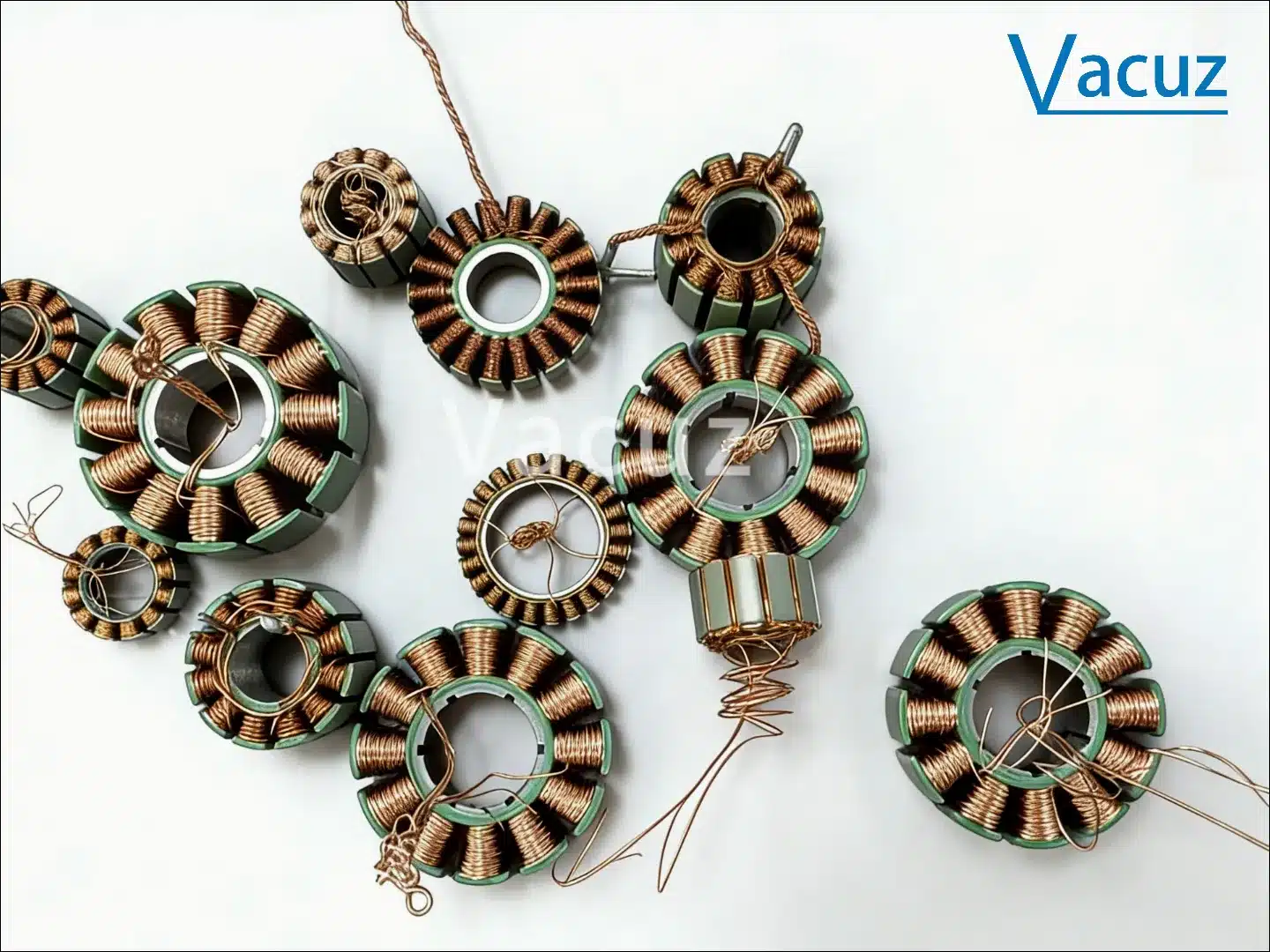
I. Production Standards: Comprehensive Specifications from Equipment Configuration to Process Control
1. Equipment Precision and Configuration Standards
Die Precision: Die machining tolerances must be strictly controlled within ±0.03mm, with surface polishing to Ra≤0.2μm to avoid scratching the enameled wire.
Transmission System: Utilizing high-rigidity ball screws and linear guides, with repeatability ≤±0.05mm, providing a foundation for layered winding.
Tension Control: A closed-loop feedback system dynamically adjusts tension, with a fluctuation range of ±0.5N, adapting to different wire diameters (e.g., Φ0.08-Φ1.3mm) and speed requirements. For example, for fine wire (Φ0.08mm), the winding speed needs to be reduced to 80%, and dynamic tension compensation should be used.
2. Process Parameter Standards
Stator Parameter Matching:
Outer Diameter: Standard machine applicable Φ20-Φ130mm; exceeding this requires custom-made equipment.
Stack Thickness: Generally controlled within 5-80mm; exceeding this limit requires custom-made equipment.
Slot Spacing: When wire diameter ≤ Φ0.3mm, slot spacing is 2.5-3mm; for multi-wire parallel winding (e.g., 30 Φ0.2mm wires), the slot spacing needs to be increased.
Winding Speed and Tension:
During high-speed winding, the copper wire vibration amplitude must be ≤ ±0.01mm, achieved through an active vibration reduction algorithm.
When multi-wire parallel winding, inter-wire interference needs to be addressed through electromagnetic field simulation to optimize wire diameter and spacing design, combined with real-time tension compensation to reduce short-circuit risk.
3. Environmental and Safety Standards
Environmental Control: Constant temperature (±2℃), constant humidity (≤60%), to prevent softening of the enameled wire.
Safety Precautions: Equipped with protective covers and an emergency stop mechanism (response time ≤ 0.5 seconds). Operators must wear protective gear, and it is strictly forbidden to put hands into the work area during operation.
4. Quality Inspection Standards
Wire Laying Error: Copper wires must be arranged according to the groove outline, with an error ≤ ±0.02mm. Interlayer insulation paper positioning error ≤ ±0.1mm.
Tension Fluctuation: Fluctuation throughout the entire process ≤ ±3% to prevent wire breakage or coil loosening.
Insulation Test: After winding, a salt water test is performed to ensure that the leakage current value meets the standard.
II. Winding Techniques: From Basic Operation to Advanced Optimization
1. Basic Operation Techniques
Wire Selection and Matching:
Select copper wire, aluminum wire, etc., according to product requirements, and confirm wire diameter, groove distance, and equipment compatibility. For example, when winding multiple wires in parallel, a finer wire diameter (e.g., Φ0.2mm) should be selected.
Study the product specification sheet in detail and communicate with the supplier to confirm wire specifications to avoid incorrect material selection.
1. Tension Control:
Use a high-quality tensioner and fine-tune the tension value according to the tension table. For example, reduce the tension to 0.5N for thin wire and increase it to 2N for thick wire (e.g., Φ1.0mm).
Dynamically adjust the tension to adapt to different winding speeds to avoid sudden tension changes that could cause wire breakage.
2. Die and Wire Laying Device Coordination:
Gradually adjust the position of the die and wire laying device through full-winding adjustments to ensure the winding effect meets requirements. For example, for needle-type winding machines, adjust the positioning of the wire laying device, needle bar, wire nozzle, and stator frame.
Keep the wire laying wheel and wire clamp perpendicular and adjust them to the same height, using specialized tools for fine-tuning.
3. Advanced Optimization Techniques:
Intelligent Programming and Path Optimization:
Generate a 3D winding path model using CAD software to optimize the winding sequence and avoid crossings or overlaps.
Use a laser displacement sensor to monitor the copper wire position in real time, with a deviation ≤ ±0.05mm, and automatically correct for issues such as missing wires and overlaps.
Multi-wire winding and thick wire handling:
When winding multiple wires in parallel, optimize wire diameter and spacing design (e.g., wire spacing ≥ 0.5mm), combined with real-time tension compensation (deviation ≤ ±0.3N) to reduce short-circuit risk.
When winding thick wire, polish the die to Ra ≤ 0.4μm, apply a lubricating layer to reduce friction, and adjust the speed as slowly as possible to avoid damaging the wire at bends.
Visual inspection and automatic correction:
Monitor the wire laying status in real time using a high-speed camera, automatically correcting defects such as missing wires and overlaps.
Use a PLC/CNC system to precisely adjust parameters such as the number of turns and speed, ensuring an error between adjacent slots ≤ ±0.05mm.
4. Maintenance and debugging techniques
Regular maintenance:
Clean the wire guide rollers, replace worn parts (such as felt and wire tips), and establish equipment health records.
Upgrade the power supply system and introduce IoT remote monitoring to achieve predictive maintenance.
Debugging and Prototyping Techniques:
In manual mode, adjust step by step, observing the accuracy of mold positioning to avoid pin collisions or misalignment of the stator slot with the mold head during automatic operation.
Initially run the winding machine at a slow speed, and gradually increase the speed to the specified range after confirming there are no problems.

What are the production standards for brushless stator winding machines? What are some winding and wiring techniques? Vacuz has provided a simple explanation above, and we hope this information will be helpful!
 English
  Spanish
  Portuguese
  Italian
  German
  French
  Russian
  Turkish
  Polish
  Ukrainian
  Japanese
  Korean
  Chinese (Taiwan)
  Chinese (China)