















Assembling a brushless motor rotor involves a series of complex processes, requiring the design and assembly of numerous components. To improve production efficiency, using a rotor assembly line is undoubtedly the best approach. So, what are the configuration and requirements for a brushless motor rotor assembly line? How do you choose a reliable manufacturer? Below, Vacuz will provide a brief introduction!
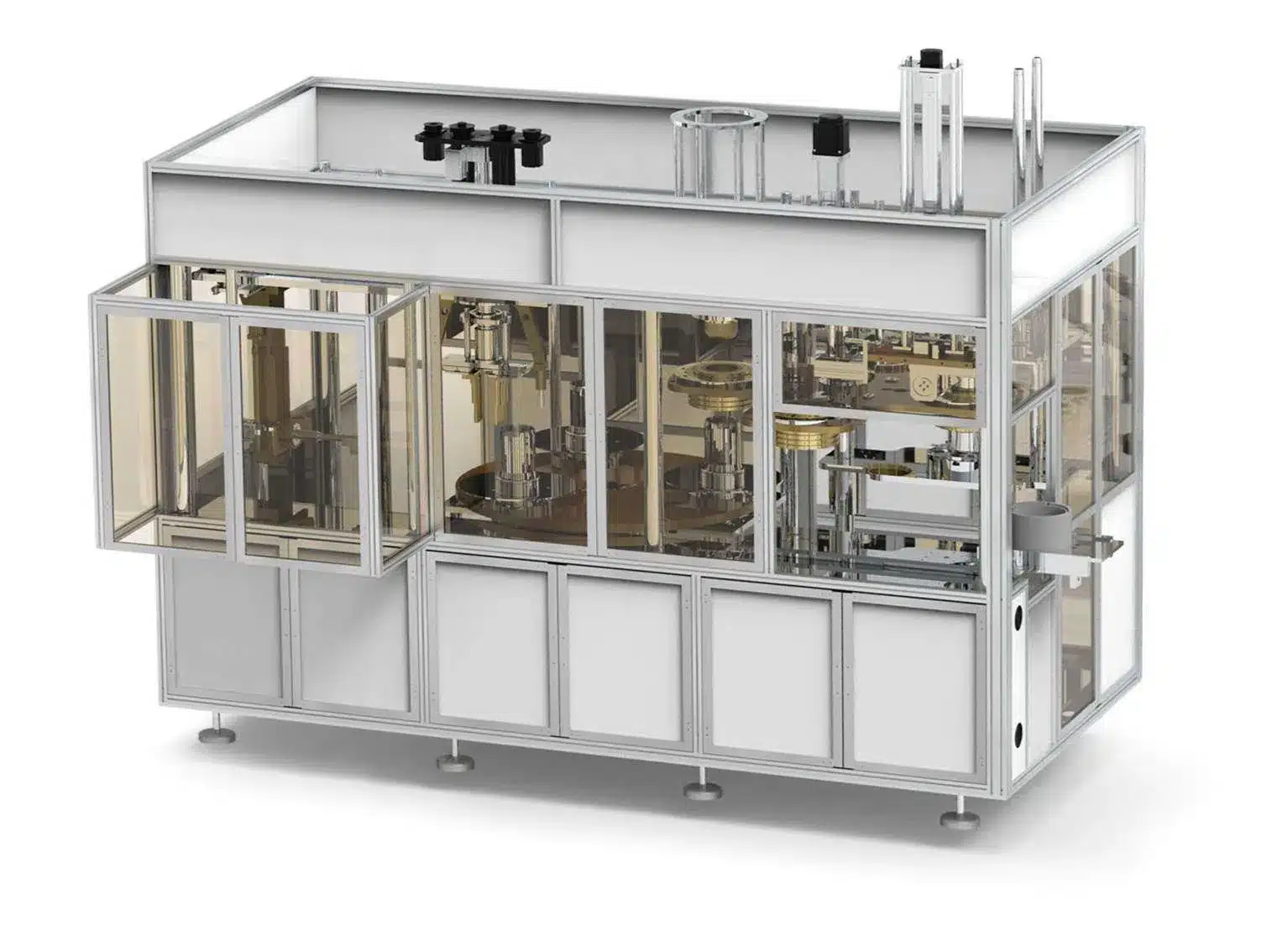
I. Core Configuration Requirements
1. Mechanical Structure and Transmission System
High-precision components: Precision ball screws, guide rails, cylinders, servo motors, and drivers are required to ensure equipment operational stability. For example, laser displacement sensors and piezoelectric ceramic fine-tuning devices can be used to achieve real-time closed-loop control of the air gap, controlling the concentricity error between the rotor shaft and magnets to ≤0.01mm.
Modular design: Supports rapid model changeover and expansion. For example, through quick-change fixtures and program pre-storage technology, two product models can be switched within 30 minutes, adapting to the needs of multi-variety production.
Multi-station collaboration: Integrates processes such as core loading, magnet insertion, shaft pressing, and balancing, reducing manual intervention. For example, a production line integrating 12 workstations reduces labor costs by 80%.
2. Electrical and Control Systems
PLC Main Control System: Integrates an industrial computer and HMI interface, supporting parameter storage, production data traceability, and remote debugging. For example, RFID chips record the raw material batch, production parameters, and testing data for each rotor, enabling quality traceability.
Sensor Network: Configured with Hall effect sensors, force sensors, displacement sensors, etc., to monitor magnet polarity, pressing force, and position accuracy in real time.
Safety Protection: Equipped with overcurrent protection, protective grounding circuits, and audible and visual alarm systems to ensure operational safety.
3. Automation and Intelligent Functions
Full-Process Automation: From core loading to bearing pressing, magnetic measurement, and dynamic balancing, all processes are completed automatically, reducing manual intervention.
Intelligent Detection and Feedback: Integrates a visual positioning system (such as a high-resolution industrial camera + AI algorithm) and online inspection equipment (such as a laser measuring instrument) to achieve ±0.3° polarity positioning and μm-level dimensional detection.
Data-Driven Optimization: Real-time acquisition of data such as pressure, displacement, and temperature via edge computing to dynamically adjust process parameters.
II. Key Process Requirements
1. Precision Control
Air Gap Uniformity: The air gap design range is typically 0.1-1mm. It needs to be checked using a laser measuring instrument and an air gap gauge, and uniformity is achieved by adjusting the stator or rotor position.
Coaxiality and End Face Parallelism: The coaxiality between the rotor shaft and the stator inner hole should be ≤0.02mm, and the end face parallelism ≤0.05mm, to avoid vibration or noise during high-speed rotation.
Magnetic Pole Alignment: The alignment error between the rotor magnets and the stator slots should be ≤1° electrical angle. High-precision alignment is achieved using an encoder or Hall effect sensor for positioning and a servo motor drive.
2. Materials and Processes
Magnet Performance: Gradient magnets (high coercivity on the surface, high remanence in the core) are used to improve high-temperature performance.
Insulation Treatment: The insulation resistance between the stator winding and the core is ≥100MΩ (500V DC test). Insulation performance is enhanced through impregnation (e.g., epoxy resin) and drying (120℃/4h).
Dynamic Balancing Correction: The imbalance is controlled to ≤0.5g·cm, corrected by weight removal (drilling) or counterweight (welding balance blocks).
3. Environment and Cleanliness
Cleanliness Standard: The assembly environment must reach Class 10,000 cleanliness, equipped with air showers and dust removal equipment to prevent dust from entering the air gap and causing wear or short circuits.
Temperature Control: The temperature of impregnation, drying, and other processes is controlled at 120-150℃ to avoid aging of the insulation materials.
III. Reliable Manufacturer Selection Criteria
1. Technical Strength and Patents
Prioritize manufacturers with more than 10 rotor assembly-related patents, such as Vacuz, which possesses core technologies such as air gap closed-loop control and gradient magnets.
Confirm whether the manufacturer collaborates with universities or research institutions to promote technological iteration.
2. Industry Experience and Case Studies
Vacuz serves leading clients in the new energy vehicle and industrial robot sectors, having previously served renowned companies.
3. Service System and Response
Full lifecycle service: including installation and commissioning, operation training, 2-year warranty, and regular maintenance. For example, Vacuz provides 48-hour on-site service.
Customization Capability: The ability to adjust equipment structure according to irregularly shaped workpieces or special processes (e.g., supporting rotor production with outer diameters of Φ30-Φ200mm and stack thicknesses of 10-300mm).
4. Cost-Effectiveness and Certifications
Price Comparison: Vacuz rotor equipment is 10%-15% lower than the market price for the same configuration, suitable for cost-sensitive customers.
Certification Standards: Certified by ISO9001, CE, TUV, etc. (e.g., Vacuz products comply with ISO/DIN standards), ensuring quality meets international requirements.
IV. Recommended Manufacturer
Vacuz
Advantages: Focused on brushless motor rotor assembly lines, mastering core technologies such as air gap closed-loop control and gradient magnets, serving leading clients in the new energy vehicle and industrial robot sectors. Representative model: The high-precision rotor assembly line supports rotor production with an outer diameter of Φ30-Φ200mm and a stack thickness of 10-300mm, an air gap error of ≤0.01mm, and a changeover time of 30 minutes.

What are the configuration and requirements for a brushless motor rotor assembly line? How to choose a reliable manufacturer? Vacuz has provided a brief explanation above, and we hope this information will be helpful!
 English
  Spanish
  Portuguese
  Italian
  German
  French
  Russian
  Turkish
  Polish
  Ukrainian
  Japanese
  Korean
  Chinese (Taiwan)
  Chinese (China)