


























The application of fully automatic motor stator winding machines solves the problem of stator winding, improving efficiency and product consistency. However, when customizing a winding machine, many related knowledge points need to be considered. So, what are the customization conditions for a fully automatic motor winding machine? What technical knowledge is required? Vacuz will give you a brief introduction below!

I. Fully Automatic Motor Winding Machine: Customization Conditions (Inputs you must provide/confirm)
1) Stator (Core) Geometric Parameters (Determines machine type/station/mold)
Outer Diameter OD / Inner Diameter ID: Determines the number of stations (commonly 4/6 stations, a single station also exists); a large OD may require fewer stations, a small ID limits winding space/clamping method.
Height (Stack Thickness/Axial Length): Generally,>70 mm requires custom configuration; >150 mm is mostly non-standard; height directly affects the wire runout, risk of wire damage, and mechanism stroke.
Slot number, slot type, slot direction (inward/outward):
Outward slot → Multiple choice: Flying fork external winding machine (high efficiency, low cost);
Inward slot → Multiple choice: Needle-type internal winding machine (higher wire routing accuracy, commonly used with brushless motors).
Slot distance/slot width: Determines whether the wire can pass smoothly and whether it will be scratched; too small a distance requires higher equipment precision (usually ±0.01 mm).
It is recommended that you provide: OD/ID/H, number of slots, slot direction, slot width, slot distance (center distance between adjacent slots) in drawings or photos.
2) Coil/winding parameters (determine control strategy and mechanism selection)
Wire diameter range: Commonly 0.02–1.2 mm;
Fine wire (<0.1 mm) → Requires precise tension, sensitive to wire breakage;
Thick wire (>0.8 mm) → Requires reduced speed, increased tension, possibly larger wire nozzle/stronger wire routing mechanism.
Number of turns, number of parallel windings (how many wires are wound together):
Multi-wire parallel winding (e.g., 30 0.2 mm wires wound together) → requires synchronous tension/synchronous wire feeding, and an anti-entanglement wiring system; this is a high-end requirement.
Winding topology: Concentrated winding vs. distributed winding; span/pitch, number of layers, whether insulation paper is required (interlayer insulation), end shape, etc.
Coil inner/outer diameter, end length constraints: determine the wiring stroke and winding space.
3) Process parameters (determine whether the equipment is “good enough”)
Winding speed: Commonly 1000–3000 RPM for single-station operation; multi-station operation can increase the cycle time by 3–5 times; however, the speed is limited by wire diameter/number of turns/height.
Accuracy Requirements (Critical, directly impacting configuration):
Turnings Error: ≤±1 turn (Common target)
Wire Laying/Positioning Accuracy: ±0.01–0.03 mm
Tension Fluctuation: Copper wire 0.5–5 N, fluctuation ≤±0.5 N (high-end requires ±0.2 N)
Tension Range and Control Method: Copper wire 0.5–5 N, Aluminum wire 0.3–3 N; Closed-loop tension feedback (tension sensor + PID/feedforward) is required for stability.
Changeover Time Target: Common requirement ≤15 min (including mold change + parameter adjustment); Higher requirement ≤5 min (requires quick-change fixtures + process database).
4) Automation and Production Line Integration (Determines the degree of “fully automated”)
Loading and Unloading: Robotic arm/dedicated fixture + vision positioning (positioning accuracy commonly ±0.02 mm); Whether to interface with the production line (conveyor line/MES).
Automatic Functions List (check each item): Automatic threading, automatic wire cutting, automatic corner wrapping, automatic wire changing (multi-wire diameter switching), automatic detection.
Online Inspection/Quality:
Turner count, wire diameter detection, insulation withstand voltage/salt water test (after production).
Online Vision: Wire breakage/jump/overlap detection (accuracy down to 0.1 mm).
Data and Remote Control: Production statistics, yield rate, remote monitoring (Ethernet/4G/5G), predictive maintenance.
5) Environment, Safety, and Standards
Temperature and Humidity: Recommended workshop temperature 20±2℃, 50±5%RH; the equipment itself must be dustproof and anti-static.
Vibration Reduction: Ground vibration ≤0.5 mm/s; vibration damping is often required.
Safety: Safety light curtains, emergency stop, protective cover; must comply with CE/UL, etc. (required for export).
Lifetime/Reliability Indicators: MTBF ≥5000 h is a common target.
II. What Technical Knowledge Do You Need?
Parameterized Process Debugging: Number of turns, starting point, wire spacing, number of layers, tension curve, speed curve, acceleration/deceleration time—each item must be verifiable.
First Article Inspection Process: Appearance → Dimensions → Number of turns → Resistance → Withstand voltage/salt water → Dynamic balancing (if required).
Tension “Golden Window”: Tension must be recalibrated for different wire diameters/heights on the same machine; a common practice is to perform a DOE (Design of Engineering).
Die and Stator Matching: Burrs/dirt on the slot opening → will inevitably damage the wire; die wear → wire misalignment; die life management must be established.
Fault Mode List: Wire breakage, skipped wires, incorrect number of turns, wire overlap, tension alarm, visual false alarm, material jamming during loading/unloading; each type must have a corresponding troubleshooting SOP.
Maintenance Plan (PM): Tension spring/belt/lead screw lubrication/wire tip wear/sensor calibration cycle (e.g., replace tension spring every 5000 cycles).
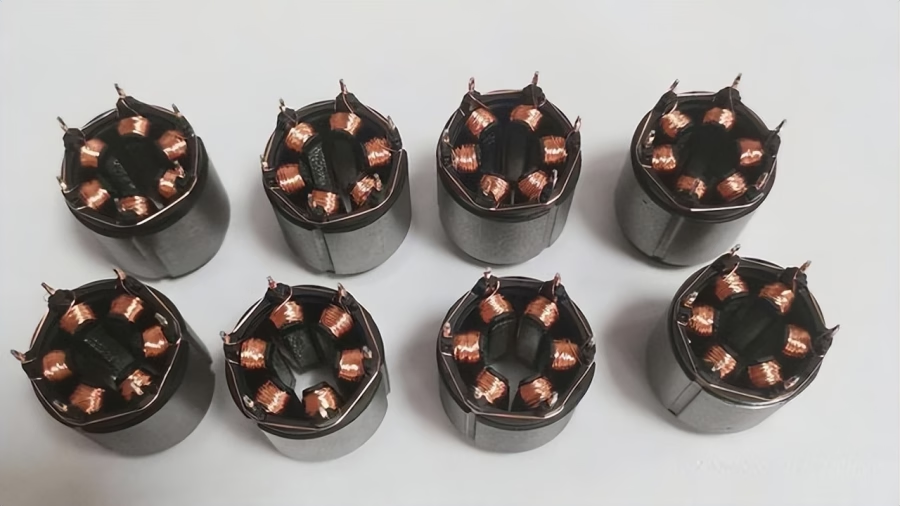
What are the customization requirements for fully automatic motor winding machines? What technical knowledge is required? The above is a simple explanation, and I hope this information can be helpful to everyone!